
Honoring Your Past Without Letting It Own Your Future

Kylian Mbappé was nine years old when Nike found him. At nine, most of us were still making major life decisions based on who had the best snacks. He was beginning a relationship with one of the biggest brands in sports—a relationship that would follow him from a promising child to one of the most recognizable athletes in the world.

That history matters. Nike believed in him before most of the world knew his name. There is something honorable about remembering who opened a door before there was a crowd waiting on the other side.

A young soccer player ties an unbranded cleat beside an empty field at sunrise.

But memory isn’t a contract with no ending.

After roughly two decades with Nike, Mbappé has signed with the younger Swiss company On. According to Reuters, the new agreement includes cash and equity as On prepares to enter soccer. The move appears to offer him more than another endorsement check. It gives him a stake in what comes next.

That’s where gratitude gets complicated.

We tend to believe that the people and places that recognized an earlier version of us have earned some permanent claim on every version that follows. The boss who gave you your first real opportunity. The town that raised you. The career that fed your family. The relationship that loved you when you had less to offer.

Those gifts are real. They deserve to be remembered honestly. But a gift is not a deed.

I’ve spent most of my adult life in the car business. It has provided for my children, introduced me to people I never would have known, and taught me how to read a room, listen beneath an objection, lead under pressure, and own a result. It also taught me that Saturday is apparently a workday with better football games happening somewhere else.

I’m grateful for that life. Gratitude doesn’t require me to pretend it must be the only life I ever build.

A dealership manager carries a notebook and work bag toward the showroom exit at dusk.

Writing a book didn’t erase the years behind a desk or on a sales floor. If anything, those years gave me something worth writing about. The next chapter does not have to insult the previous one in order to be legitimate. I can admit that a place shaped me without insisting it owns the shape I take next.

That’s the difference between loyalty and captivity.

Loyalty is chosen in the present. It’s mutual, honest, and awake to what the relationship has become. Captivity is yesterday’s favor turned into today’s veto. It says, “We believed in you then, so you owe us the right to decide who you become now.”

Sometimes staying is the responsible choice. Children need stability. Bills don’t become less due because you have discovered your calling; the electric company has never accepted personal growth as payment. Dreams need plans, savings, patience, and occasionally the humility to move slower than your ego would prefer.

But sometimes leaving is also responsible.

You can give notice instead of disappearing. You can train the next person, finish the work, keep your promises, and speak well of the people who helped you. You can leave without rewriting the past into a prison or a villain. A good departure can be evidence that the old place taught you something about character.

The same is true beyond work. A town can remain home without defining the boundary of your life. A relationship can have saved an earlier version of you without being entitled to govern the next one. A role can have been right for a season and still become too small for the person that season helped create.

Footprints cross an open wooden doorway and continue along a country path toward morning light.

Gratitude should make us honest about what we received. It should not make us dishonest about what we have become.

You can honor the door that opened for you without agreeing to spend your whole life standing in its frame.

Every Skyline Stands on Someone You Forgot to Thank

One World Trade Center gets photographed from almost every angle human beings can think of, including several we probably didn’t need. The glass catches the sky. The spire carries the symbolism. The height gets printed in guidebooks.

Underneath all that attention is enough concrete to pave more than 4,000 New York City blocks.

The concrete makes up the tower’s core, foundation, and floor slabs. It holds the building in place while the more photogenic parts collect compliments. Nobody visits Manhattan, points toward the ground, and says, “Look at that magnificent footing.”

Concrete is the second-most-used material on Earth after water, which is a remarkable career for something most of us notice only when we trip over it. John Wilson’s new film, The History of Concrete, considers the material beneath our buildings, sidewalks, garages, and roads—the substance carrying modern life while blending almost completely into the background.

One World Trade Center rises above the massive concrete structure supporting the skyline.

That made me think about Lorraine.

In A Love Song for Bobby Long, Lorraine Will never appears. We don’t hear her version of events. We don’t even get a photograph. Yet she may be the most important character in the movie. Pursy’s return, Bobby’s collapse, Lawson’s history, the house, the secrets, the resentment, and much of the love all exist in the shape of her absence.

She’s the concrete of the story. Everyone else gets the dialogue, but they are standing on what she left behind.

Real life is full of people like that.

At a dealership, the delivery photograph usually shows a smiling customer, a salesperson, and a clean vehicle. It can look as though the salesperson personally mined the metal, assembled the truck, arranged the financing, and buffed the tires with his own shirt.

Outside the frame are the people who stocked the vehicle, found the keys, corrected the paperwork, cleaned what somebody else missed, answered the phone, handled the title, fixed the warning light, and caught the mistake before it became the customer’s problem. Their best work often produces no story at all. The emergency never happens, so nobody knows who prevented it.

A dealership employee quietly prepares a pickup truck before a customer delivery.

Fatherhood can be invisible in the same way. Children remember the vacation, the birthday, or the Christmas gift. They may not remember who checked the tires before the trip, stayed awake listening for the door, kept the insurance paid, or carried private worry without making it the household weather.

Small towns are held together by similar people: the maintenance worker who arrives before the building opens, the church member who somehow knows where every folding table lives, the school secretary who can solve six problems before the rest of us finish explaining the first one. Their reliability becomes so familiar that we stop seeing it as labor.

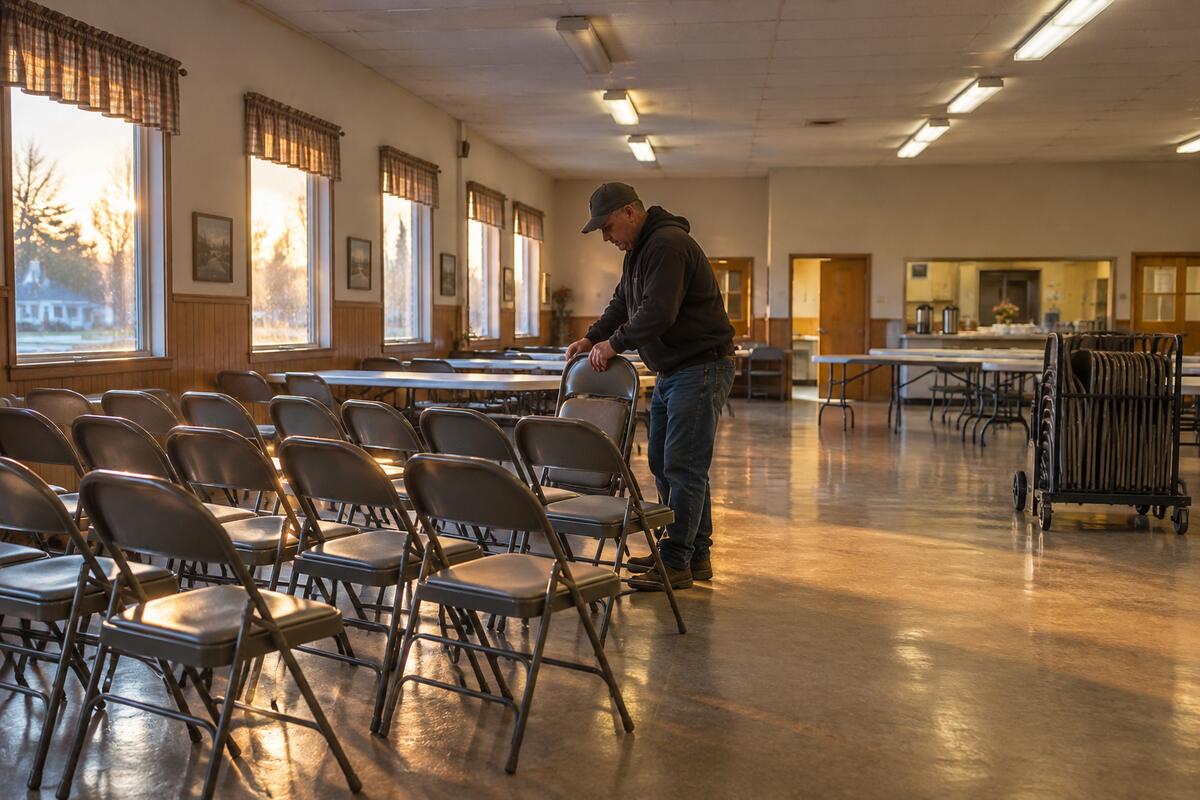
A maintenance worker arranges folding chairs in an empty small-town community hall.

That’s the strange penalty for making stability look ordinary.

This is not simply an argument that dependable people deserve more applause. Most foundations aren’t asking for a parade, and concrete would probably be uncomfortable with the attention. The deeper problem is that invisible support is often treated as unlimited support.

We keep adding floors because the building hasn’t fallen yet.

Then the dependable employee burns out. The quiet spouse stops compensating. The father who always handles it admits that he can’t. The institution everyone assumed would remain begins to crack. Only then do we study the structure and act surprised by how much weight it had been carrying.

Maybe appreciation matters most before the failure—not as praise, but as relief. Share the load. Learn the process. Notice what keeps working and ask who is making that possible. Foundations need inspection, maintenance, and occasionally somebody willing to stop building long enough to protect what is already holding the place up.

We photograph the skyline because it’s beautiful. We should.

But every skyline is standing on something it forgot to thank.