Is Your Porch Light On? Halloween, Boundaries, and Belonging

By seven o’clock on Halloween night, a porch lights in Dardanelle and small towns all over the county become legal documents.

Light on means come up the driveway, ring the bell, display the costume, and receive candy. Light off means keep moving.

The agreement is so widely understood that children who have ignored their parents for most of the evening can suddenly interpret a boundary with constitutional precision. Nobody has to explain it. Nobody knocks on the dark house for twenty minutes because the people inside may secretly want company.

They trust the signal.

Costumed children walk toward a warmly lit front porch on Halloween evening.

Adults are not always as honest with one another.

We say we want closer relationships while making ourselves difficult to reach. We say our door is always open while answering every interruption with a sigh. We tell our children they can talk to us about anything, then begin correcting them before they finish the first sentence.

The words say welcome.

The porch is dark.

I know something about living that way. After enough disappointment, distance begins to feel like wisdom. If nobody gets close, nobody can leave a hole when they go. You can call it independence, caution, maturity, or peace.

Sometimes it is just loneliness with excellent security.

I’ve wanted people to notice I was inside while doing everything possible to make the house look empty. I’ve hoped someone would knock while giving them every reasonable indication that knocking would be unwelcome.

Then I’ve wondered why the evening was quiet.

Costumed children pass a dark porch and walk toward a brightly lit house.

The people around us read more than what we say.

Children study our faces when they bring home a mistake. Employees watch what happens to the first person who delivers bad news. Friends remember whether their last honest confession became ammunition. A person may hear “You can tell me anything,” but he believes what happened the last time he tried.

That doesn’t mean everyone is entitled to unlimited access.

A porch light is not an unlocked front door. It doesn’t give every passing stranger the right to walk into the living room, eat dinner, and leave with the entire bowl of Reese’s Cups. Welcome and access are not the same thing.

Boundaries still matter. Some people belong at the curb. Some conversations need to happen at a better time. Some relationships have earned a locked door.

The light simply says an approach will not be punished.

That distinction matters in fatherhood. A child doesn’t need a father without standards. He needs one whose standards don’t make honesty dangerous. If every mistake produces anger before understanding, the child may not improve his behavior. He may simply improve his hiding.

It matters in leadership too.

An open-door policy means very little if the manager’s expression says, “You’ve made a serious error by walking through it.” Employees usually bring small problems before they bring large ones. How the small problem is received helps determine whether the large one arrives while it can still be solved.

A father listens closely to his costumed child beneath a warm porch light.

The porch light is built through repetition.

It’s the phone placed facedown when someone starts talking. It’s the question asked without rushing toward an answer. It’s the apology that proves pride does not own the house. It’s responding to an inconvenient truth in a way that makes another truth possible later.

None of this guarantees that anyone will come.

That’s the difficult part.

You can become more available and still spend an evening alone. People may not trust the light yet. They may remember when it was dark. They may have learned another route home. Invitation is not control, and vulnerability doesn’t create a debt somebody else must repay.

But we are responsible for the signal we send.

On Halloween night, children don’t examine the intentions of the people sitting behind closed curtains. They look at the house. The light is either on or it isn’t, and they make their decision from the road.

The people we love often do the same.

The porch light can’t make anyone knock. It can only keep the darkness from answering for you.

When Responsibility Is Really Pride in Disguise

We have a strange rule about asking for help: smoke should be visible first.

The account should be nearly empty. The workload should be breaking us. The marriage should be in crisis. The deadline should have already passed, preferably while making a dramatic whistle overhead.

Apparently, only then are we permitted to admit that another pair of hands might be useful.

Until that moment, asking feels excessive. Why call the fire department when the curtains are only warm?

Dan Lewis recently did something quieter. After sixteen years of sending readers a curious story most weekdays through Now I Know, he asked them to contribute financially. But he made an important distinction. The newsletter was not about to disappear. Reader support would make the work stronger, more sustainable, and less dependent on advertising.

He wasn’t asking readers to pull him from a burning house.

He was asking whether they might help reinforce the structure while it was still standing.

A homeowner and carpenter reinforcing the foundation of a sturdy Arkansas house before an emergency.

That shouldn’t sound unusual, but it does.

We understand maintenance when it involves roofs, vehicles, and air conditioners. Nobody waits for the engine to fall onto Highway 7 before admitting the oil probably should have been changed. Yet we routinely demand more obvious damage from our finances, relationships, health, faith, and emotional lives before treating support as justified.

I have done this in nearly every role I have held.

As a manager, I can convince myself that carrying the pressure alone protects everyone else. As a father, I can mistake being dependable for never appearing burdened. As a writer, I can keep adding work to the calendar because admitting I need time, encouragement, attention, or support feels suspiciously close to complaining.

Pride is clever that way. It rarely introduces itself as pride.

It calls itself responsibility.

A dealership manager working alone after closing with paperwork and empty desks around him.

Responsible people can become especially good at waiting too long. We absorb another task, cover another expense, postpone another conversation, and reassure everyone that we have it handled.

Sometimes we do have it handled.

That doesn’t mean handling it alone is wise.

The danger is not merely exhaustion. When we refuse help early, we often increase the eventual cost for everybody nearby. The employee who never delegates eventually leaves behind a system nobody else understands. The spouse who never voices a need eventually speaks from resentment. The father who hides every struggle may believe he is giving his children security while accidentally teaching them that adulthood means suffering privately until something breaks.

Even prayer can become something we postpone until desperation makes it feel respectable. We wait until we have exhausted our own wisdom before asking God, a pastor, or a trusted friend to help us see what pride has hidden.

Asking earlier doesn’t guarantee an answer. Other people are allowed to say no. A reader doesn’t owe a writer money. A friend can’t carry every burden. A team should not be asked to compensate forever for poor leadership.

But a clear request made while choices still exist is different from an emergency handed to someone after every other option has been consumed.

Neighbors arriving with tools to help maintain a sturdy Arkansas home before serious damage occurs.

There is courage in saying, “Nothing is collapsing today, but I can see what will happen if I continue this way.”

That may mean hiring help before the workload becomes impossible. Having the financial conversation before the late notice arrives. Seeking counseling before every exchange becomes evidence in an imaginary trial. Telling a friend the truth while the problem is still small enough to describe without a timeline and supporting documents.

Help is most useful when it still has room to be help instead of rescue.

The strongest structures aren’t the ones that never needed reinforcement. They’re the ones somebody cared enough to inspect before the weakness became visible from the road.

Asking for help while the house is still standing isn’t weakness.

It is stewardship.

Turn Rejection into Opportunity: Master Your Fear

Choose what you’re going to fail at today.

That sounds like irresponsible advice. Most of us spend our days trying to prevent failure, not schedule it. We double-check the email, soften the question, delay the call, and wait for more certainty. If we are careful enough, maybe we can get through the day without being told no, looking foolish, or discovering that we aren’t as ready as we hoped.

Chris Voss recently shared the story of a man who deliberately chose five things to risk failing at each day. Then he wrote down what every miss taught him.

He wasn’t choosing five ways to cause damage. He was choosing five meaningful attempts whose outcomes he could not control. That’s a very different thing.

A man’s hand writing five lines in a notebook beside dealership keys and a morning cup of coffee.
A failure quota begins as a list of attempts, not a wish for damage.

A failure quota sounds backward until you realize it is really an action quota with the ego removed.

Sales makes this easier to see. At a dealership, we measure calls because a call is controllable and the result is not. A salesperson can dial the number, follow up, ask a useful question, and invite the customer to take the next step. He cannot order another human being to answer, trust him, show up, or buy.

That uncertainty makes avoidance attractive. A salesperson can’t hear “no” on a call he never makes. His record remains clean. Unfortunately, his month usually does too.

The scoreboard may say he avoided rejection. The calendar says he forfeited an opportunity.

A salesperson making a follow-up call from a modest vehicle dealership office during a quiet morning.
Calls are measurable precisely because outcomes are not.

The same trick applies outside the showroom.

A writer who never shares the work can’t be rejected by the readers. A manager who keeps postponing a difficult conversation can’t mishandle it today. A person considering a career change can’t be passed over for a job he never applies for. In every case, doing nothing protects us from an immediate loss while quietly guaranteeing that nothing new can happen.

Avoidance protects the record by forfeiting the season.

I understand the instinct because I am good at finding responsible-looking ways to obey it. There’s always an email that needs answering, a report that could be improved, a drawer that suddenly deserves organization, or another hour of research that feels almost like movement. Safer errands do not announce themselves as fear. They arrive wearing work clothes.

Once, I even ended a good relationship because I didn’t want to risk it becoming bad. But that’s a separate post altogether.

That’s why a failure quota can be useful. It exposes the difference between being busy and being available for an outcome you cannot control.

The quota doesn’t require five disasters. It might mean making the calls you have been avoiding, sending the application before you feel perfectly qualified, asking for the opportunity, letting somebody read the draft, or beginning the conversation that has been living rent-free in your head. The purpose isn’t to collect rejection for its own sake. The purpose is to make enough honest attempts that rejection no longer has the power to organize your life.

A tired writer and job seeker preparing to send work from a laptop at a kitchen table after dark.
The record stays perfect only when nothing is risked.

There’s another benefit to recording what each miss teaches you. Failure stops being a verdict and becomes information. The customer’s objection sharpens the next conversation. The unanswered application reveals where your résumé or network needs work. The confused reader shows you where the writing is not yet clear. The hard conversation teaches you which words opened the door and which ones closed it.

None of this means every attempt is wise. Repetition doesn’t excuse sloppiness, and courage is not the same as recklessness. A good failure quota still requires preparation, judgment, and a willingness to adjust. It simply refuses to let perfection become the price of participation.

At the end of the day, five unsuccessful attempts may look like a bad day on paper. But compare it with the day spent circling every risk and accomplishing only what could not reject you. One produced bruises and information. The other produced a full schedule and no evidence that fear was ever challenged.

The goal isn’t to become comfortable with losing. It’s to become more loyal to the work than to the image of yourself as someone who never misses.

If rejection belongs to the work, put it on the calendar before fear fills the day with safer errands.

The Spotify Wrapped Setting Parents Need—and Might Not Use

Spotify Wrapped arrives each year like a personality test administered by an algorithm.

Here are the artists you loved. Here are the genres that define you. Here is the song you played so many times that perhaps you should speak with someone.

Then you open yours and discover that your carefully cultivated musical identity has been defeated by the same song your child requested 47 times from the back seat.

You thought you were building the profile of a thoughtful, emotionally complicated adult. Spotify thinks you are a nine-year-old girl preparing for a dance recital.

Parents finally have an escape. Spotify now offers a setting that excludes children’s and family music from the taste profile used to create Discover Weekly, Daily Mix, and Wrapped. It even works retroactively, removing earlier children’s listening from the picture.

To be fair, the setting makes sense. A parent may not want animated princesses controlling every future recommendation. Taylor Swift, K-pop, and the songs Jaxson records himself would not necessarily qualify as children’s music anyway. The button has limits.

But one phrase in Spotify’s announcement caught me: the change is supposed to keep Spotify “more you.”

A father looks at a colorful year-end music summary on his phone while children wait in the back seat.

I understand what the algorithm means. It’s trying to identify what I would choose if no one else were in the car.

Fatherhood has made that a harder question to answer.

Naomi brings Taylor Swift and K-pop into the rotation. Jaxson doesn’t merely listen to music; he makes his own. Ben can take control of the stereo and introduce a selection I would never have found—or chosen—on my own. Some of those songs become tolerable. A few become good. Others remain evidence that love occasionally requires endurance.

None of them may represent my solitary taste. All of them represent my actual life.

That’s where an algorithm and a family measure identity differently. The algorithm tries to isolate the individual by removing outside interference. Family life works in the opposite direction. It continually interferes. It changes what you hear, where you go, how you spend your time, and eventually who you understand yourself to be.

A father drives through Arkansas while his three children sing and choose music together.

Parents are often tempted to protect a private, uncontaminated version of themselves. We want proof that beneath the practices, school schedules, cartoon phases, and commandeered car stereos, the original person is still in there somewhere.

He is.

But he isn’t the whole truth anymore.

The songs my children choose may not tell you what I would play alone. They can tell you who rode beside me that year. They can remember a drive to practice, an argument over the next song, a chorus everybody knew, or one of Jaxson’s tracks played while I tried not to look too impressed.

A clean profile might describe my preferences more accurately while describing my life less honestly.

I’m not arguing that parents should never use the feature. Sometimes a recommendation is only a recommendation, and nobody needs six months of cartoon soundtracks following him through adulthood. This isn’t really about a Spotify setting.

It is about the parts of parenthood we are tempted to edit out because they don’t feel sufficiently ours.

A father drives alone at dusk with the empty passenger seats visible behind him.

One day, none of my children will ask for control of the music.

It will happen without an announcement. There will be no final ceremonial handoff of the phone. The requests will become less frequent. Someone will start driving a separate car. Someone will leave home. Eventually, my recommendations may become perfectly accurate again.

The drives will also become quieter.

That’s the bargain hidden inside so many parental annoyances. The interruption ends. The evidence goes with it.

So let the children bend the algorithm for a while. Let Naomi leave some glitter in the data. Let Ben confuse the recommendations. Let Jaxson put something on the record that no other parent’s listening history contains.

The profile doesn’t have to describe who I would have been without them. I already know that man existed.

I’m more interested in the one their music helped create.

If your children ruined your Wrapped, they may have told the truth about your year.

The Power of Pausing in Negotiations

The offer lands on the table. You make a counter. Then the other person looks down at the paper and says nothing.

Three seconds pass.

Nothing has technically gone wrong, but fear doesn’t need evidence. It begins writing the rejection for them.

“I know that may be too much.”

“Of course, I’m flexible.”

“It’s really not that big of a deal.”

“Never mind.”

The other person has not declined the request. They haven’t even responded to it. Yet, in an attempt to relieve the pressure, we lower the number, soften the boundary, or withdraw the ask altogether.

The negotiation is lost internally before the other side has had a chance to participate.

A job candidate waits quietly after making a salary request while the hiring manager considers it.

I’ve spent most of my adult life in the car business, much of it in sales and F&I offices. Silence changes those rooms.

Numbers are presented. A customer looks at the page. Maybe he leans back. Maybe she glances toward the door. The seconds suddenly feel much longer than they are.

An inexperienced salesperson often treats that silence like a hole that must be filled. He starts explaining something nobody questioned. Then he offers a discount nobody requested. Sometimes he negotiates both sides of the deal and acts surprised when his own side loses.

But silence is not automatically rejection. It may mean calculation, surprise, confusion, discomfort, or strategy. Sometimes people simply need a moment to think.

Silence is information, not a verdict.

A finance manager and customer sit with the quiet that follows a dealership proposal.

That lesson becomes harder to remember when the thing being negotiated belongs to us.

A salary is not just a number. It can feel like a public measurement of our worth. A promotion asks somebody to judge whether we are ready. A boundary risks disappointing someone we care about. A protected hour for writing requires us to believe our work deserves space before anyone else has validated it.

Fear likes to disguise itself as reasonableness.

It calls surrender humility. It calls self-erasure flexibility. It tells us we are being easy to work with when we are really making ourselves easier to overlook.

That doesn’t mean every request should be granted. Courage is not demanding that the answer be yes. Good negotiation requires preparation, rapport, and some understanding of the other person’s concerns. Compensation is more than base salary. Relationships contain needs on both sides. Time has limits.

The point is not to become unreasonable. The point is to stop doing the other person’s rejecting for them.

A father protects an early-morning hour for writing before the rest of the day begins.

Make the honest request. Name the concern you believe the other side may have. Explain the value. Then stop talking long enough to receive an actual answer.

If the answer is no, you have learned something real. You can negotiate another part of the offer, revise the request, hold the boundary, or decide whether the opportunity still fits.

But a no delivered to your full request tells you more than a yes to the half-sized version fear allowed you to make.

I have watched silence cost people money in a finance office. I have also watched fear cost people years outside of one. The currency changes, but the first concession sounds the same: “I probably wasn’t worth asking for it anyway.”

Do not save somebody else the trouble of underestimating you.


Source note: Inspired by The Black Swan Group’s “How to Negotiate Salary Offers: What to Say and Avoid.”

Ernest Hemingway, a Mystery Fish, and the Humility of Real Leadership

Ernest Hemingway once mailed a fish to Philadelphia.

Not a manuscript. Not a letter demanding that an editor reconsider an obviously brilliant paragraph.

A fish.

During the 1930s, Hemingway developed a working friendship with Henry Fowler, an ichthyologist at the Academy of Natural Sciences, and Academy director Charles Cadwalader. The scientists wanted to understand the game fish Hemingway encountered in the waters around Cuba, and Hemingway was curious enough to help.

He sent measurements, photographs, observations, and actual specimens packed in salt and ice.

With one uncertain fish, Hemingway reportedly included cooking instructions in case Fowler decided it was more useful as dinner than science.

That may be the most practical peer-review process ever devised.

A 1930s fisherman-writer packing an unusual fish in ice at a Cuban dock.

Fowler later named a newly described spinycheek scorpionfish Neomerinthe hemingwayi in recognition of Hemingway’s assistance with his work on Gulf Stream fish.

Hemingway didn’t discover that particular fish. He did something more ordinary and more repeatable.

He paid attention.

He noticed differences other people dismissed. He preserved information. He asked questions. Then he sent what he found to someone who knew more than he did.

Hemingway’s obvious legacy is made of sentences. This smaller one survives in a jar because he was useful outside the narrow job description of “writer.”

Modern ambition doesn’t always know what to do with that kind of contribution.

We’re trained to want authorship, ownership, and credit for the finished discovery. We want to solve the mystery, name the thing, publish the answer, and stand beside it when the picture is taken.

But much of worthwhile life is built by people who never finish the discovery themselves.

They notice.

They preserve.

They introduce.

They pass something along.

A 1930s ichthyologist examining a newly arrived fish specimen in a laboratory.

Leadership requires this more often than leaders like to admit.

A manager doesn’t need to know how to perform every repair, answer every legal question, diagnose every system failure, or understand every line of every report. He does need to recognize when the problem deserves another set of eyes.

There’s a difference between responsibility and pretending to be the smartest person in every room.

The responsible leader says, “I don’t know, but I know who should look at this.”

The insecure one guesses confidently and hopes the fish doesn’t begin smelling before anybody notices.

Fatherhood works the same way.

A child asks why he struggles to read when other children do not. He asks whether a sound from the engine matters, why somebody died, what a Bible passage means, or whether the strange thing he found near the river is valuable.

A father may not know.

That isn’t the failure.

The failure would be teaching the child that unanswered questions are embarrassing—or that Dad’s authority depends on never admitting uncertainty. Fathers could all benefit from giving fewer confident lectures five minutes before Google proves us wrong.

Sometimes the better lesson is, “That is a good question. Let’s find somebody who knows.”

A father and child showing an unusual natural specimen to a museum curator.

There are stories around Dardanelle and Yell County that work the same way.

Someone finds an old photograph, letter, tool, map, name, or memory. It may look ordinary because it has been sitting in the same drawer for forty years. The person holding it doesn’t have to understand its full significance.

He only has to recognize that it might matter.

Send the photograph to the historian. Record the story before the witness is gone. Ask the older relative. Let the mechanic hear the noise. Let the teacher see the struggle. Let the scientist examine the fish.

Humility is not saying that your contribution has no value.

It’s understanding where your contribution ends and someone else’s begins.

Hemingway could supply the specimen because he was on the water. Fowler could classify what arrived because he had spent his life studying fish. Neither man had to become the other for the work to matter.

That’s stewardship: noticing what has been placed in your hands without assuming it was placed there for you alone.

Discovery often begins when somebody says, “I don’t know what this is, but I know it should not be thrown away.”

You Can Put Down the Weight Without Reopening the Door

For years, I wanted one answer from my biological father.

Why?

Why did he leave? Why did he stay gone? Why was I not enough reason to come back?

The older I became, the more sophisticated the questions sounded, but underneath them was still a little boy trying to understand an adult decision as a verdict about himself.

Eventually I had to admit something uncomfortable: I could imagine no answer that would satisfy me.

There might have been an explanation that added context. There might have been facts I did not know. But there was no sentence capable of returning the childhood I did not have with him.

If no answer could repair the past, how long was I willing to make my future wait for one?

That question changed the way I think about forgiveness.

We often talk about forgiveness as if it requires a grand reopening. The offense is forgiven, the music swells, the door opens and everybody walks back into the same relationship with cleaner clothes and better lighting.

Real life is rarely that cooperative.

Forgiveness is not approval. It does not make abandonment acceptable, betrayal harmless or a lie true.

Forgiveness is not trust. Trust is built with evidence, and evidence may say that someone is still unsafe, unreliable or unwilling to change.

Forgiveness is not reconciliation. Reconciliation requires participation from both people. Sometimes it is possible. Sometimes it is beautiful. Sometimes it would be foolish.

And forgiveness is not renewed access.

You can release hatred and still block the number. You can forgive a relative and maintain a boundary. You can stop rehearsing an old argument without inviting the other person back into the room.

That is not bitterness.

Sometimes it is pattern recognition.

I do not say this casually. “You just need to forgive” can be an awfully cheap sentence when spoken by someone who did not pay for the wound. Some harm runs far deeper than the examples I can offer, and nobody else gets to set a deadline for another person’s healing.

But I have learned that there is a difference between honoring the truth and building a permanent home inside it.

Resentment is expensive. The person may have hurt us once, but resentment can keep charging us long after they stop participating. It takes attention, energy, trust, possibility and present moments. The original offender may be eating tacos with no idea that court is still in session inside our head.

Meanwhile, we keep arguing the case.

Something shifted for me through baseball, of all things.

My biological father was from Chicago, and when I was a child I grabbed onto the Cubs as a connection to a man I barely knew. He sent me Cubs things. I watched games on WGN. The team became partly mine because it was his.

Years later, I sat in a stadium with my own sons and watched the Cubs play. I was giving them a memory I had once wanted him to give me.

The facts did not change. He still left.

But I had moved.

I could not rewrite the father I had. I could become the father I wanted.

That was more useful than winning another imaginary argument.

The chapter about resentment in A Nobody’s Guide to Self-Help became one of the hardest for me to write because it would have been easy to make myself the innocent victim in every paragraph. That version contained some truth, but not enough of it.

Other people wounded me. I have wounded people too. I have needed forgiveness, boundaries and second chances. I have also needed consequences.

The goal is not to erase the past or pretend every relationship can be restored. The goal is to stop requiring yesterday’s permission to live tomorrow.

Sometimes putting down the weight means repairing what can be repaired.

Sometimes it means accepting the apology.

Sometimes it means giving one.

Sometimes it means grieving the apology that will never come.

And sometimes it means closing the door without standing behind it for the rest of your life.

Who or what are you still waiting on before you give yourself permission to move?

From Spouses to Friends: Navigating Life After Divorce

The marriage ended.

That sentence is supposed to finish the story. Two people divide the furniture, rearrange the calendar, learn unfamiliar versions of their children’s lives, and eventually become people who used to know each other.

That’s not what happened to us.

Our marriage did end. Nothing about what came afterward erases why it failed, repairs those years retroactively, or guarantees some romantic ending waiting around the corner. But the relationship didn’t disappear with the marriage.

Slowly—and not always gracefully—we learned how to become friends.

Two former spouses sit in a quiet Arkansas yard with respectful space between them as their children’s bicycles rest nearby.

That sounds backward. We spent years learning how to be spouses. We shared a home, raised children, carried bills, made plans, disappointed each other, and accumulated the kind of familiarity that can make two people believe they no longer need to ask questions.

Marriage gave us access to nearly every part of each other’s lives. Access, however, is not the same as attention.

After the divorce, many of the assumptions lost their authority. Neither of us could treat closeness as automatic. We had to speak more clearly, listen with less ownership, and learn where the new boundaries stood. We had to stop trying to win arguments that belonged to a house we no longer lived in.

Co-parenting required coordination, but friendship required something more. It asked us to become curious about each other again.

Two co-parents review a family calendar and a child’s school papers together at a kitchen table.

A recent School of Life essay describes friendship as a collection of abilities. A good friend can admit weakness, receive another person’s uncomfortable truth without immediately judging it, restore perspective, and help someone understand what he cannot yet explain to himself.

Those abilities sound simple until the person across from you knows exactly where you have failed.

That may be what makes this friendship meaningful to me. My ex-wife does not know a polished version of my life. She knows the evidence. She was there for mistakes I might prefer to explain more generously. I know her history in the same unedited way.

And still, we talk every day. We see each other several times a week. We raise our children from two houses without pretending the family disappeared when the marriage did. Somewhere along the way, she became what I now describe plainly: one of my best friends.

The clearest evidence may be sitting in the front of my book.

When I told her I had written A Nobody’s Guide to Self-Help, I also told her that some of the failures in its pages belonged to the life we had shared. Understandably, that made her less excited to read it. The book asked her to revisit struggles, regrets, and questions that were not mine alone.

She read it anyway.

Then she agreed to write the preface. She wrote honestly about the failures in our life together, but she also wrote about vulnerability, growth, and the possibility of building something beautiful after things fall apart. She said she was honored to contribute.

An open book manuscript and handwritten notes rest between two cups of coffee on a kitchen table.

That was not an endorsement of every version of me she had known. Friendship doesn’t require pretending the other person has always been right. It was something better: the decision to see who I had been, recognize who I was trying to become, and stand beside the work without falsifying the past.

This isn’t an argument that everyone should remain close to an ex. Some endings require distance. Some relationships become dangerous when access is preserved. Forgiveness can exist without friendship, and peace does not always require continued contact.

Our story is simply proof that a relationship can fail in its original form without becoming worthless.

Love can change jobs.

It can stop trying to possess a shared future and begin helping two people tell the truth about their shared past. It can trade certainty for curiosity, obligation for choice, and the exhausted language of spouses for the deliberate attention of friends.

The marriage ended. The friendship didn’t rise untouched from its remains. We built it from them, piece by piece, while raising three children and learning to meet each other without the old claims.

Sometimes two people cannot save the house they built, but they can still learn how to meet each other honestly in the yard.

Crafting Your Legacy: Stories Over Resumes

Some time after my funeral, a friend of mine will sit across from someone who never knew me.

The flowers will be gone. The formal praise will be over. Nobody will be standing behind a podium trying to summarize an entire life before the next song begins. The stranger will ask a simple question.

“What was Scottie like?”

My friend won’t recite my résumé. He won’t list the years I spent in the car business, the titles I held, the number of vehicles I sold, or the book I managed to finish. He’ll tell a story.

Maybe it will be about a phone call I returned when it would have been easier not to. Maybe an apology that came without an excuse attached. Maybe a night I stayed when leaving would have been more convenient.

It’ll be something small enough to tell across a table and true enough to carry the weight of my name.

That’s how a life outlives a body—not as a thesis, but as a scene.

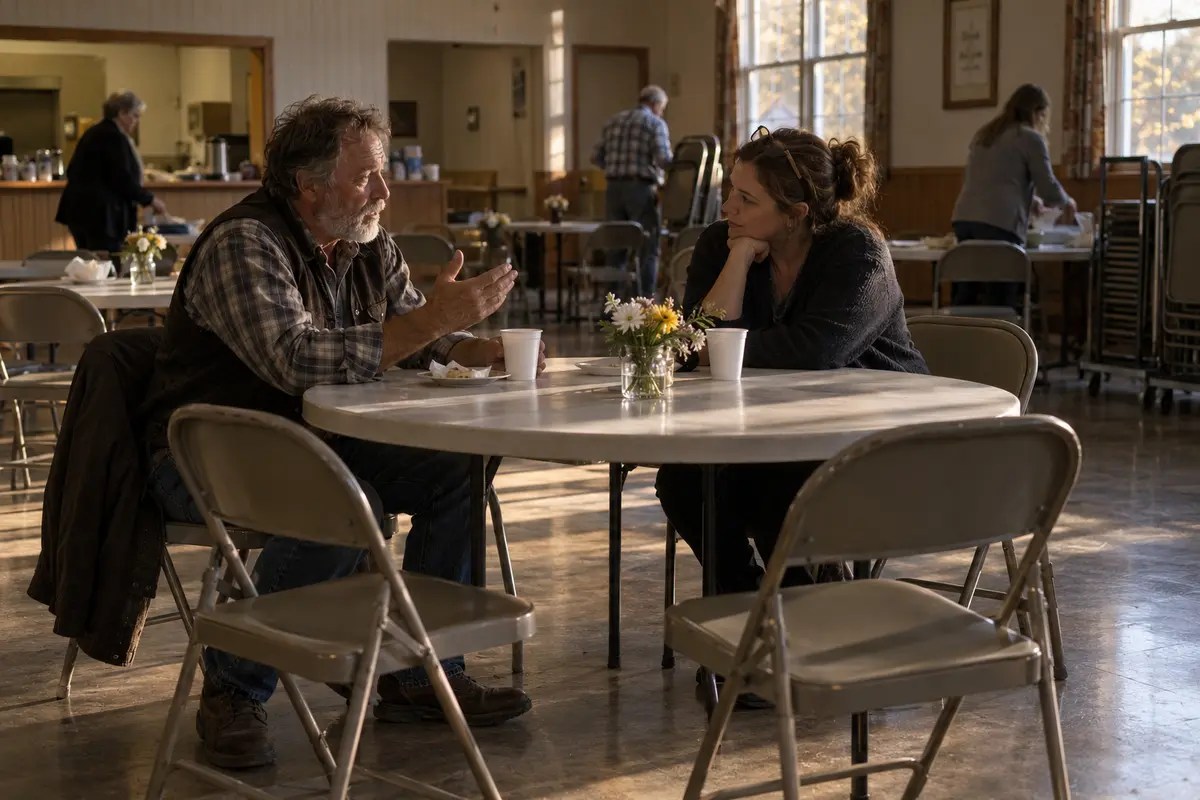
Two people remain in a quiet church fellowship hall after a memorial gathering, sharing a story across a table.

A résumé is written in nouns. Memory is told in verbs.

We’re remembered for what we did when someone needed us, what we said when the truth cost something, and whether our stated values survived an inconvenient Tuesday. Accomplishments may introduce us, but conduct explains us.

I’ve spent enough time writing A Nobody’s Guide to Self-Help to know how tempting it is to treat legacy as a publishing problem. Put the right ideas into a book and maybe the best part of you will survive.

But words only testify. The people who lived beside us get to cross-examine them.

I can write about patience and still hurry a child who is trying to tell me something. I can write about responsibility and protect my ego when an apology is due. I can write about mortality, then spend an ordinary Tuesday as if I have an unlimited supply of them.

Near the beginning of the book, I used seven words from an obituary: “There are no services planned at this time.” They felt cold and final, like somebody had closed a book. I kept returning to death because it’s the one deadline none of us can negotiate.

But the point was never to stare at the closed book. It was to notice that this page is still open.

A manager takes responsibility in front of his team during a quiet dealership meeting.

My children won’t remember every lesson I tried to teach them. They will remember patterns. What repeatedly received my time? Was home safe enough for the truth? Did work always win? Did I listen only when the timing was convenient?

An employee may forget the speech but remember the day a leader took responsibility in front of everyone. A friend may not remember the advice but remember that the phone was answered. Someone we love may forget the argument and keep the apology.

Faith quietly teaches me that life is stewardship, not ownership. I don’t control the number of pages. But I am responsible for what I place on this one.

A father stays at the kitchen table late at night and listens while his child talks.

This isn’t a call to manufacture cinematic moments. Most legacy looks ordinary while it is happening. Return the call. Tell the truth before you are caught. Sit for ten more minutes. Put the phone down. Apologize without turning it into a courtroom defense.

I can’t control every story people will tell about me. Memory is imperfect, and so am I. But I can give the people around me better material.

Someday my name will need an introduction. Someone who loved me, worked with me, or survived me will choose one small scene to explain who I was.

Live one story today that would still be worth telling when your name needs an introduction.


Source note: Inspired by The School of Life newsletter, “Lessons In Living Before Dying.” This essay also revisits themes from A Nobody’s Guide to Self-Help.

Anything You Pretend to Be Long Enough Eventually Hires You

Vincent Gigante shuffled through Greenwich Village in pajamas, slippers, and a bathrobe.

He muttered to himself. He appeared confused. If law enforcement came near, the performance reportedly became more dramatic.

Most people use a bathrobe to avoid getting dressed. Gigante used his to avoid federal prison.

Behind the confused old man was the calculating leader of the Genovese crime family. For decades, the performance helped him delay prosecution. Doctors examined him. Relatives and associates supported the story. He entered hospitals repeatedly and carried the character into courtrooms.

In 2003, Gigante finally admitted that he had intentionally misled the doctors evaluating whether he was competent to stand trial.

The bathrobe had been a costume.

The performance had become a career.

An older man in a bathrobe and pajamas walking through Greenwich Village while observers watch from a distance.

There’s nothing admirable about the criminal enterprise underneath that costume, and this story shouldn’t be used to suggest that real mental illness is a performance. Mental illness is real, often invisible, and difficult enough without people treating every symptom as suspicious.

But the human mechanism underneath Gigante’s fraud is still recognizable.

People create characters to protect themselves.

The harmless joker never has to risk being taken seriously. The hard manager doesn’t have to admit that criticism hurt. The man who “doesn’t care” can’t be rejected because he has already announced that nothing matters. The person who is always helping everyone else never has to explain why he can’t ask for help himself.

Even humility can become a disguise.

Calling yourself a nobody may keep ambition from sounding arrogant. It may also lower the stakes. If you’re only a nobody writing a book, then nobody can reasonably expect the book to be good. If the work succeeds, you exceeded expectations. If it fails, you can pretend you never expected anything from it.

That’s useful protection.

It can also become a very comfortable bathrobe.

An exhausted dealership manager sitting alone in his office after closing.

Most protective personas begin for a reason.

Maybe humor once kept tension from becoming conflict. Maybe toughness was necessary in a home where vulnerability was punished. Maybe indifference arrived after caring too much became painful. Maybe shrinking yourself prevented other people from accusing you of thinking too highly of yourself.

The costume worked.

That’s why you kept it.

But a defense built for one season can quietly become an identity. The danger passes, yet the performance continues. Eventually, the people around you stop knowing where the character ends and you begin.

Worse, you may stop knowing too.

Maintaining the role requires constant labor. The joker must always find the punch line. The strong one must recover in private. The indifferent man must pretend not to notice what he is losing. The nobody must minimize every accomplishment quickly enough that nobody suspects he wanted it badly.

The costume protects you from judgment by preventing anyone from seeing enough of you to judge.

It also prevents them from seeing enough of you to love.

A man speaking honestly with a trusted friend at a kitchen table in the morning light.

Removing the costume does not require making a public announcement or confessing every private fear to the nearest cashier.

It may begin with one honest sentence.

“I cared more than I admitted.”

“That embarrassed me.”

“I acted angry because I felt threatened.”

“I keep making jokes because I don’t know how to ask whether you are disappointed in me.”

The first appearance without the costume may feel less authentic than the performance. That’s what happens when rehearsal has lasted longer than honesty.

Gigante’s act required doctors, relatives, hospital visits, courtroom behavior, and decades of repetition. The disguise may have delayed consequences, but it demanded a remarkable amount of his life in return.

Our smaller performances collect payment too.

They take intimacy, rest, possibility, and the freedom to respond honestly instead of asking what the character would do next.

Anything you pretend to be long enough eventually hires you full time.