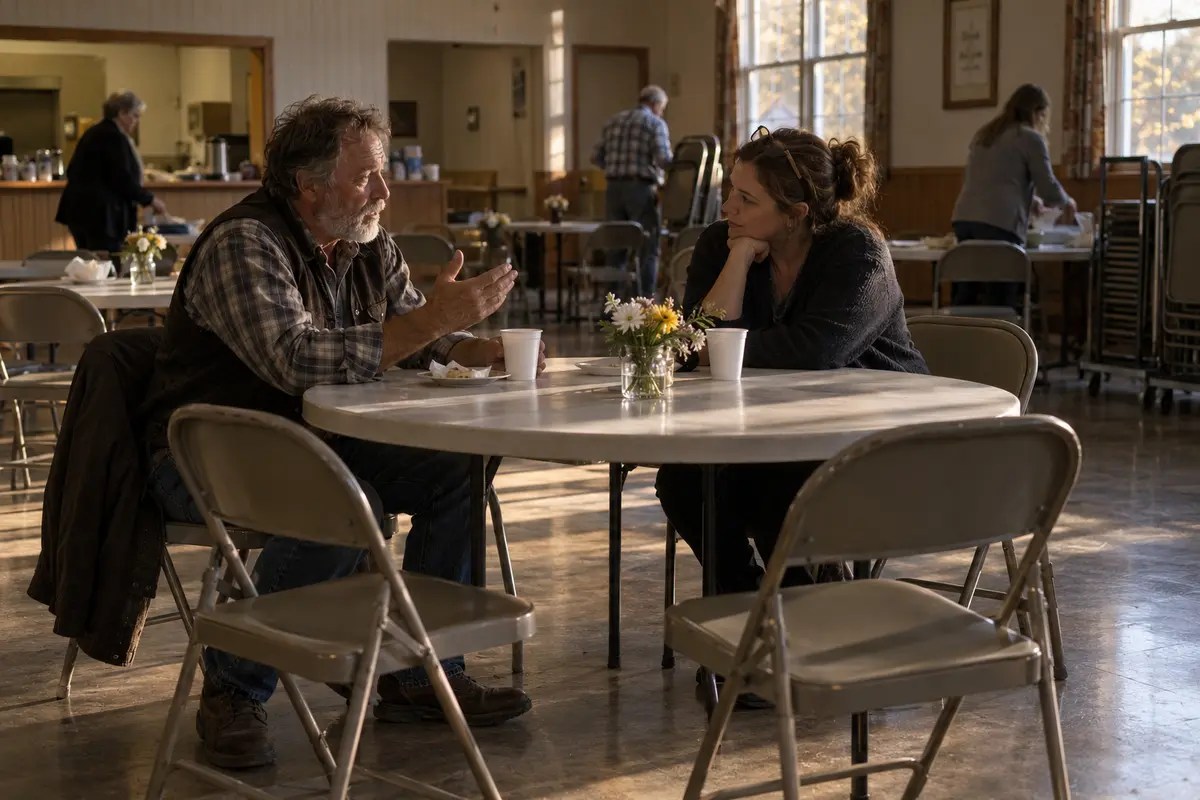
Crafting Your Legacy: Stories Over Resumes

Some time after my funeral, a friend of mine will sit across from someone who never knew me.

The flowers will be gone. The formal praise will be over. Nobody will be standing behind a podium trying to summarize an entire life before the next song begins. The stranger will ask a simple question.

“What was Scottie like?”

My friend won’t recite my résumé. He won’t list the years I spent in the car business, the titles I held, the number of vehicles I sold, or the book I managed to finish. He’ll tell a story.

Maybe it will be about a phone call I returned when it would have been easier not to. Maybe an apology that came without an excuse attached. Maybe a night I stayed when leaving would have been more convenient.

It’ll be something small enough to tell across a table and true enough to carry the weight of my name.

That’s how a life outlives a body—not as a thesis, but as a scene.
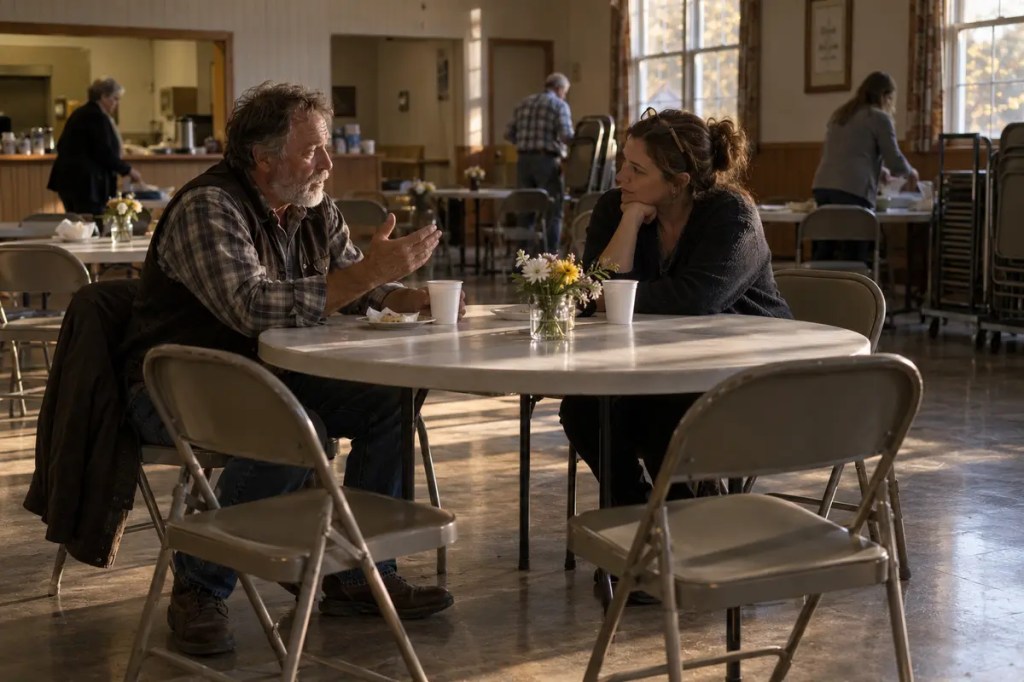
Two people remain in a quiet church fellowship hall after a memorial gathering, sharing a story across a table.

A résumé is written in nouns. Memory is told in verbs.

We’re remembered for what we did when someone needed us, what we said when the truth cost something, and whether our stated values survived an inconvenient Tuesday. Accomplishments may introduce us, but conduct explains us.

I’ve spent enough time writing A Nobody’s Guide to Self-Help to know how tempting it is to treat legacy as a publishing problem. Put the right ideas into a book and maybe the best part of you will survive.

But words only testify. The people who lived beside us get to cross-examine them.

I can write about patience and still hurry a child who is trying to tell me something. I can write about responsibility and protect my ego when an apology is due. I can write about mortality, then spend an ordinary Tuesday as if I have an unlimited supply of them.

Near the beginning of the book, I used seven words from an obituary: “There are no services planned at this time.” They felt cold and final, like somebody had closed a book. I kept returning to death because it’s the one deadline none of us can negotiate.

But the point was never to stare at the closed book. It was to notice that this page is still open.

A manager takes responsibility in front of his team during a quiet dealership meeting.

My children won’t remember every lesson I tried to teach them. They will remember patterns. What repeatedly received my time? Was home safe enough for the truth? Did work always win? Did I listen only when the timing was convenient?

An employee may forget the speech but remember the day a leader took responsibility in front of everyone. A friend may not remember the advice but remember that the phone was answered. Someone we love may forget the argument and keep the apology.

Faith quietly teaches me that life is stewardship, not ownership. I don’t control the number of pages. But I am responsible for what I place on this one.
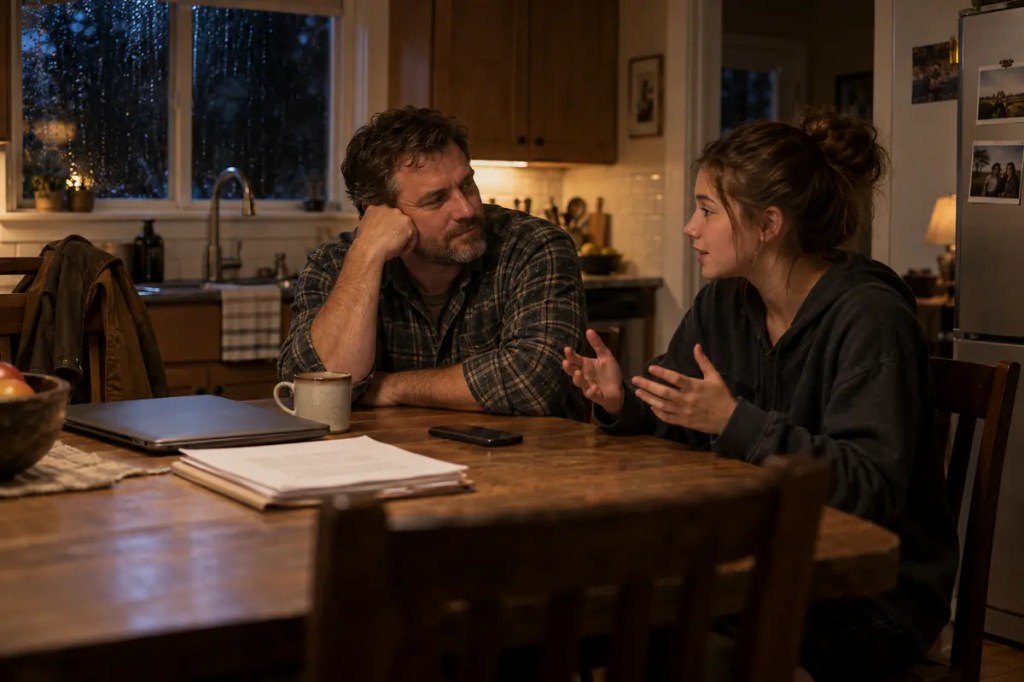
A father stays at the kitchen table late at night and listens while his child talks.

This isn’t a call to manufacture cinematic moments. Most legacy looks ordinary while it is happening. Return the call. Tell the truth before you are caught. Sit for ten more minutes. Put the phone down. Apologize without turning it into a courtroom defense.

I can’t control every story people will tell about me. Memory is imperfect, and so am I. But I can give the people around me better material.

Someday my name will need an introduction. Someone who loved me, worked with me, or survived me will choose one small scene to explain who I was.

Live one story today that would still be worth telling when your name needs an introduction.


Source note: Inspired by The School of Life newsletter, “Lessons In Living Before Dying.” This essay also revisits themes from A Nobody’s Guide to Self-Help.


Accumulating Love: The Dimes of Fatherhood

There is a bar bet hiding in the bottom of your change jar.

Pour any ordinary mixture of modern American dimes, quarters, and half dollars onto a kitchen scale. Do not count them. Don’t sort them. Just keep adding coins until the scale reaches one pound.

The pile will be worth approximately twenty dollars.

It sounds like a trick because the denominations are different. The dime is worth ten cents, the quarter twenty-five, and the half dollar fifty. But their weights rise in almost perfect proportion to their face values. A quarter weighs two and a half times as much as a dime. A half dollar weighs twice as much as a quarter. The faces change. The scale keeps arriving at essentially the same answer.

Modern dimes, quarters, and half dollars rest together on a kitchen scale.

Fathers have our own way of assigning value, and I think we often get it backward.

We put a high price on the half-dollar moments: the vacation, the expensive Christmas gift, the perfectly planned Saturday, the speech we hope our child remembers for the rest of his life. We save for them, photograph them, and feel the pressure to make them count.

Those moments matter. I want my children to have adventures, celebrations, and stories big enough to retell. But most fatherhood does not arrive in half dollars.

It comes in dimes.

It’s listening to a story you’ve already heard. Sitting through another practice after a long day at work. Helping with an assignment that has frustrated both of you. Checking the weather before a game. Taking one more shot in the driveway. Looking up from the phone when a child says, “Watch this.” Saying goodnight, then showing up again tomorrow.

None of those moments feels large enough to become a legacy while it is happening.

Accumulated, they acquire weight.

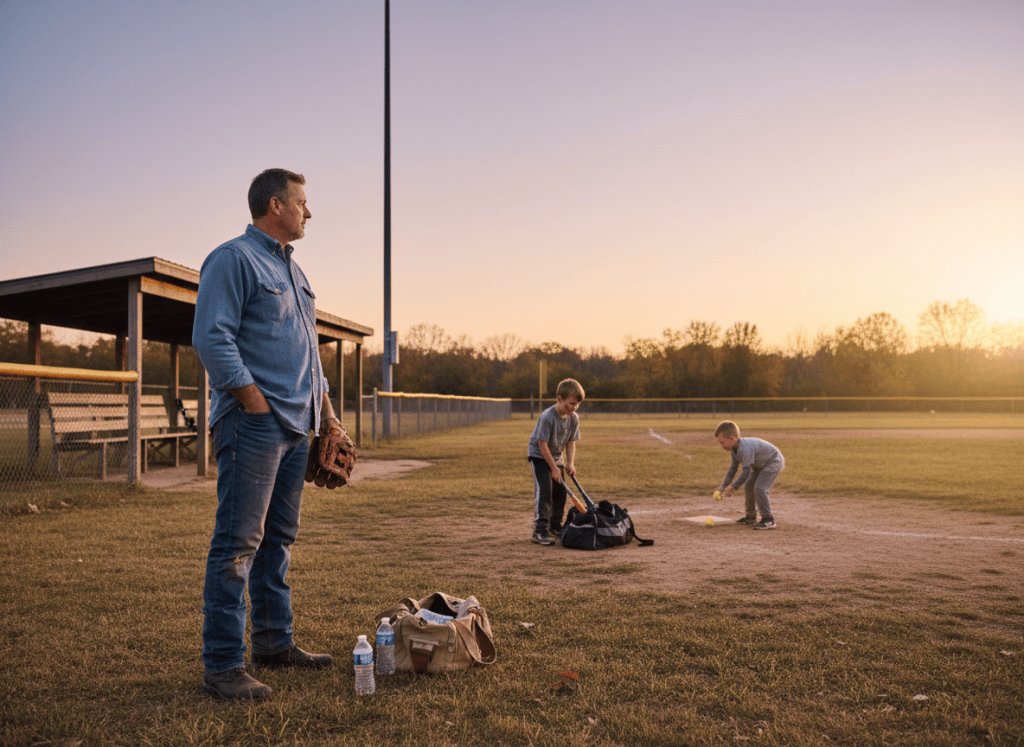
A father waits beside a quiet ballfield after practice while his children gather their things.

I have three children, and there’s a temptation to judge my fatherhood by the days I can make impressive. Did we go somewhere memorable? Did I buy the right gift? Did I say something wise enough to survive adolescence?

Meanwhile, the ordinary chances keep passing through my hands.

A child may forget the restaurant but remember that Dad listened in the car. He may forget the score but remember looking toward the fence and finding me there. He may not remember the exact night we worked through the assignment, but he will remember whether confusion felt safe in my presence.

That’s how attention becomes a childhood. Not usually through one grand act, but through hundreds of small confirmations: You matter. I see you. I came back.

The coin comparison has limits. Not every act of parenting is equal, and family life is not an accounting system where enough small kindnesses erase a deep wound. A careless word can carry enormous weight. So can an apology. Presence without attention is not the same as being present.

The point is not arithmetic. It is accumulation.

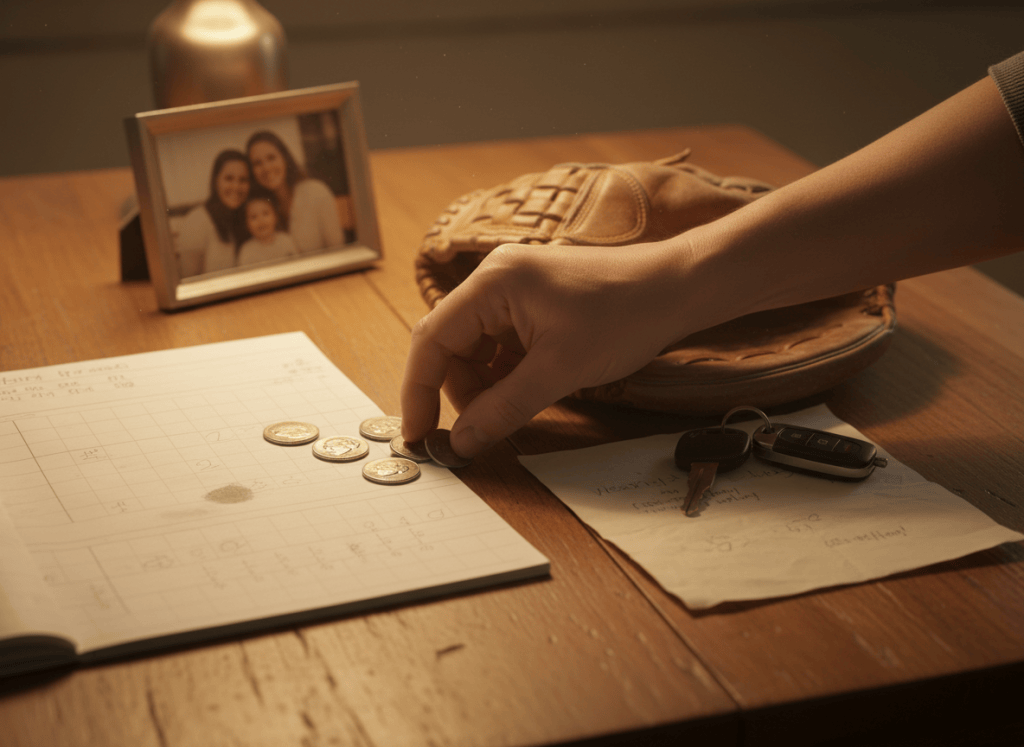
A handful of dimes lies beside homework, a baseball glove, and car keys on a family kitchen table.

An occasional spectacle can’t do the work of consistently dependable love. The biggest vacation of the year can’t replace the ordinary Tuesday when a child needs ten unhurried minutes. The perfect fatherly speech can’t substitute for becoming the kind of father whose everyday conduct has already said the same thing.

Perhaps that should relieve some of the pressure.

We don’t have to manufacture a defining memory every weekend. We don’t have to purchase every experience or turn every family outing into proof that we’re doing fatherhood correctly. We can stop waiting for the grand opportunity and become more faithful with the small ones already in our pockets.

Tonight may offer nothing more dramatic than a ride, a question, a practice, a joke, or a story we’ve heard before.

Pick up the dime.

Your child may never remember its denomination, but he will remember the weight.

The River Keeps What We Throw Away

After the water level falls, a riverbank can look like a drawer somebody pulled open and forgot to close.

Mud gives back pieces of bottles, rusted metal, buttons, tools, fishing line, and things too worn to name. Some were lost. Some were thrown away. Most entered the water without ceremony because the person holding them had no reason to imagine a stranger studying them generations later.

Time changes the category.

An object can spend two hundred years as trash and become history the moment another hand lifts it from the mud.

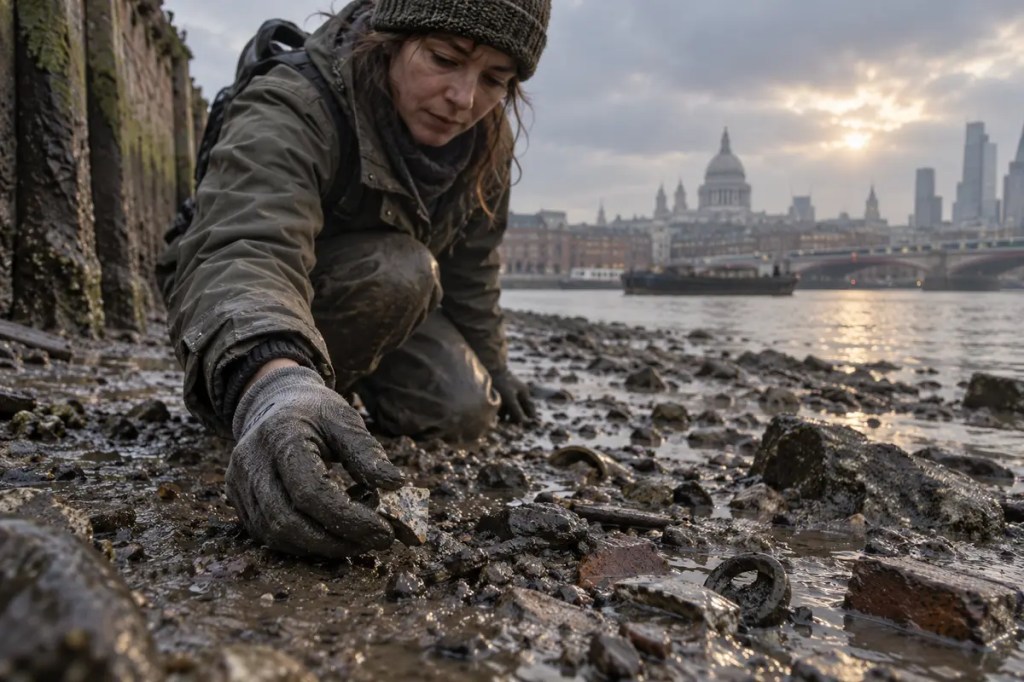
A mudlarker searches the exposed Thames shoreline and lifts a small weathered object from the mud.

The Wall Street Journal recently reported that roughly 10,000 people are waiting for permits to search the River Thames. At low tide, mudlarks move through layers of ordinary London life accumulated across centuries. Roman pottery may rest near a modern vape. A coin, buckle, pipe stem, or broken piece of tableware becomes evidence that somebody once stood there, worked there, ate there, or dropped something he assumed was gone.

The river did not preserve any of it because it understood its importance.

A river doesn’t curate. It doesn’t separate heirloom from garbage, tragedy from routine, or the final possession of a dead man from something tossed aside after lunch. It carries, buries, breaks, and exposes. Some debris is only debris. Some of it poisons the water. The river remains indifferent to every meaning we eventually place upon it.

That may be what makes the lesson honest.

The Arkansas River moves past Dardanelle without announcing which parts of our lives will matter later. History is happening in kitchens, fields, sheds, boats, church foyers, and front seats while everyone involved still calls it an ordinary day.

Low water exposes mud, driftwood, and fragments of ordinary life along the Arkansas River near Dardanelle.

We are poor judges of what an absence will make valuable.

My mother died at sixty. Grief changed the weight of ordinary things. An old photograph could knock the breath out of me, not because the paper had changed, but because the world around it had. The image became a place where someone could still be found.

That happens with more than photographs.

A phrase repeated so often that nobody bothered to record it can become the sentence everyone strains to remember. A tool is just a tool until the hands that used it are gone. A familiar drive, an unnoticed laugh, or an afternoon spent doing nothing special can become precious only after repetition is no longer possible.

We usually preserve the ceremonies. We photograph birthdays, graduations, weddings, and holidays. We assume Tuesday will take care of itself.

But much of what grief asks us to recover was hidden inside Tuesdays.

This is also the problem facing anyone who tries to preserve family or local history. We search for the dramatic story and overlook the ordinary instructions packed inside a saying, the name written on the back of a picture, the reason a certain road was avoided, or the small object nobody has thrown away because it still feels connected to a person.

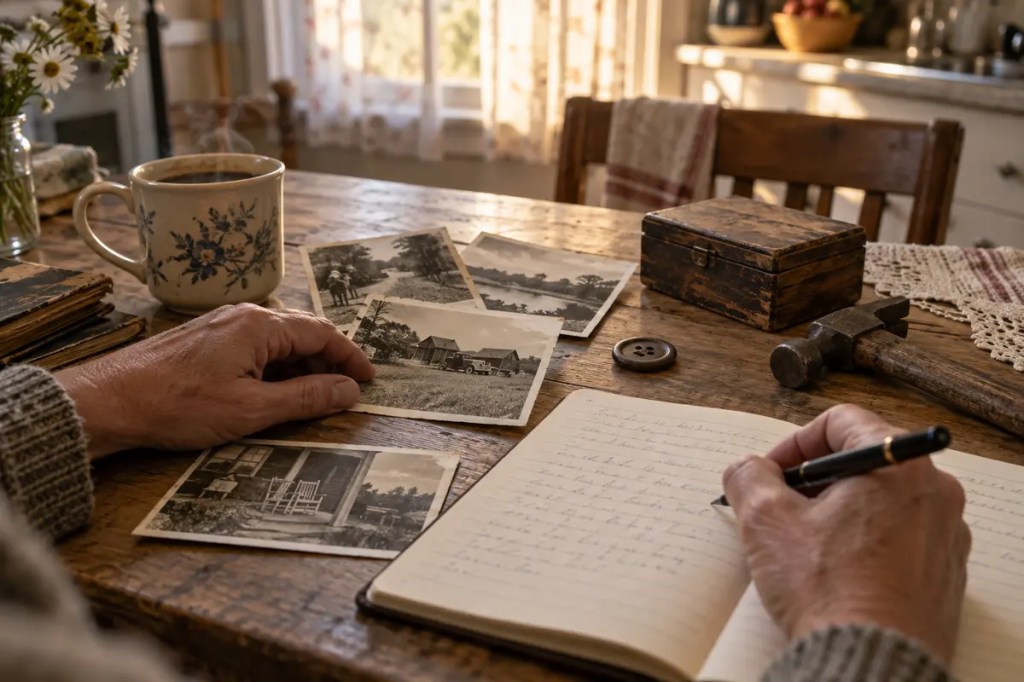
Family photographs, a worn button, and an old hand tool rest on a kitchen table while someone records their stories.

We cannot save everything. We shouldn’t even try. A life can’t become a storage unit where every receipt and broken object demands reverence. Attention is not the same as accumulation.

Still, we could become better witnesses to the life in front of us. We could ask the question while the person who knows the answer is still sitting nearby. We could write the name on the photograph. We could listen once more to the story we think we already know.

The mudlark looks at what another person discarded and sees evidence. Grief often does the same thing. It teaches us, too late, that the mundane was carrying more life than we noticed.

Maybe what we call history is often the present, rescued too late from our inattention.

Sources: Wall Street Journal: “Why 10K People Are Waiting to Search the Thames”; Wall Street Journal: “Why 10,000 People Are Clamoring to Dig in London Mud”