Returning Is Not the Same as Going Back

Seconds before Céline Dion sang the first note of her first full concert in six years, the stage probably looked much like it always had. Lights. Musicians. A waiting crowd. A microphone in the place where a microphone belongs.

But six years were standing beside her.

Illness had interrupted the life she knew. The return required years of physical and vocal work, and the road was longer and rougher than she expected. When she finally began, she became so emotional that the audience had to help carry the opening song.

That’s the part the word “comeback” usually leaves out.

A singer stands beneath a spotlight in the silent moment before beginning a return concert.

Comeback is a clean word. It makes absence sound like an intermission. It suggests someone stepped away, handled a problem, and returned to the same stage as the same person, ready to pick up exactly where she left off.

Real life is seldom that tidy.

Illness changes the person inside the body. Grief changes the person who walks back into the house. Divorce changes the person who tries to trust again. Parenthood changes the person who returns to ambitions he once imagined pursuing without interruption.

Even good change has a cost. We don’t pass through six years—or six months, or one terrible week—and remain untouched.

For a long time, I thought rebuilding meant restoring. I imagined there was an earlier version of my life sitting somewhere intact, waiting for me to find the right road back to it. If I could recover the right habits, confidence, relationships, or sense of direction, perhaps everything would feel familiar again.

But rebuilding is not restoration when the original materials have changed.

A middle-aged Arkansas writer returns to an old manuscript at a desk shaped by years of family life and change.

When I returned to writing seriously, I was not retrieving some untouched version of myself who had merely been waiting for an available afternoon. I brought the years with me: work, fatherhood, disappointment, grief, mistakes, and questions I could not have written honestly before I had lived them.

Some of those experiences reduced me. They took confidence, energy, and certainty. I would not insult anyone’s pain by pretending every loss secretly arrives as a gift. Some things hurt because they are hard, and some absences remain absences.

Still, reduced capacity does not automatically mean a lesser life.

Sometimes the person who returns is better than the one who left—not because the suffering was good, but because he learned to stop wasting what is. He may be slower but more patient. Less certain but more honest. Less impressed by appearances and more grateful for ordinary days. He may finally know which promises deserve his strength and which expectations never did.

That is a better version, even if the measurements we usually celebrate cannot detect it.

The hard part is allowing the new person to build a life he can actually inhabit. We can exhaust ourselves trying to perform at an old pace, recreate an old relationship, recover an old identity, or prove the interruption did not change us. Sometimes healing begins when we quit treating change as evidence of failure.

A man enters a familiar room again, carrying the evidence of the life that changed him.

Returning may mean singing differently. Working differently. Parenting differently. Praying differently. It may require boundaries the former version of us never needed, gratitude he never understood, and the humility to accept help when the first note will not come.

A return is still worth celebrating. But not because it erased the years away.

It is worth celebrating because the person who lived through them stood in the light as he was—changed, grateful, uncertain, and willing to begin again.

You can return to the stage, the work, the faith, or the relationship—but you cannot return as the person who left.

Sometimes that is not the tragedy. It is the gift.
How Small Time Blocks Can Create Big Changes

Two men live almost the same week.

Both wake up to an alarm, put on work clothes, answer messages before breakfast, get children where they need to go, and spend the day solving problems that didn’t exist when they left home. Both stop for groceries, help with homework, load the dishwasher, and collapse into bed carrying tomorrow in their heads.

If you watched their 112 waking hours from a distance, you might have trouble telling them apart.

But several times a week, after the house settles or before it wakes, one of them opens a document and writes. The other waits for a different season of life—one with fewer demands, more energy, and a clean stretch of time that nobody else needs.

Months later, one man has a manuscript. The other still has a reason.

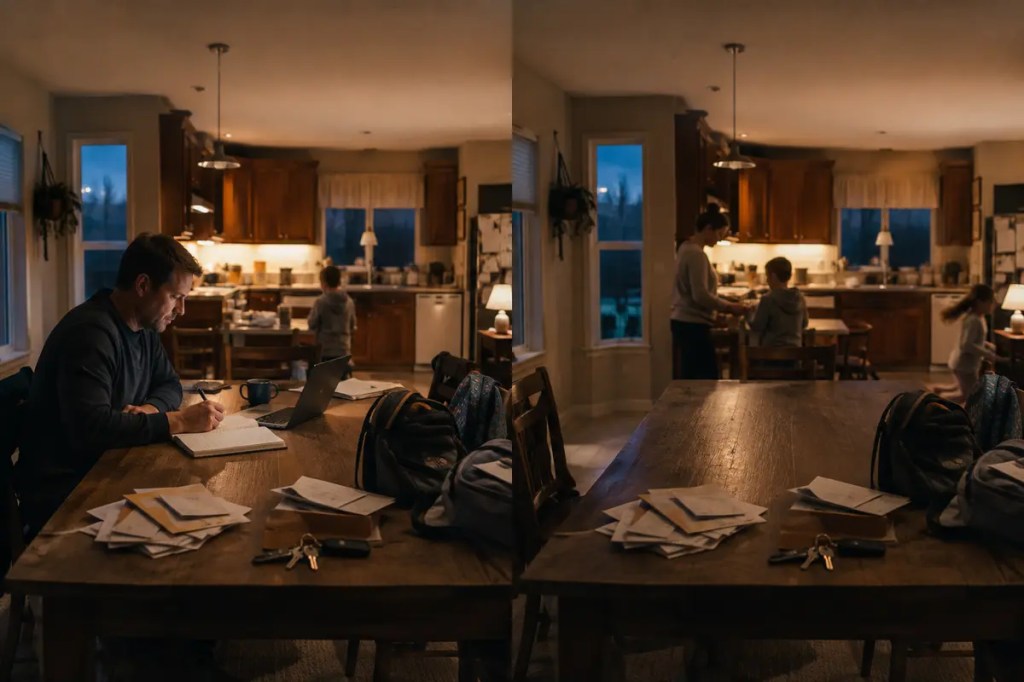
A split view of two similar family evenings, with a father writing at the kitchen table on one side and the table unused on the other.
Most of the week can look exactly the same. The difference is the hour one person protects.

In a recent 3-2-1 newsletter, James Clear shared an observation from writer and illustrator Tim Urban. Someone who writes three hours a day, five days a week, can have a book after forty weeks. The prolific writer and the person who never writes may spend six-sevenths of their waking lives almost identically. The life-changing difference is the fraction one of them defended.

We tend to imagine people who finish things as a different species. The writer wakes up inspired, lives in a quiet house, and spends whole days arranging beautiful sentences while coffee steams beside a sunlit window. That picture is convenient. If writing requires a monastery, then the rest of us are excused.

Most callings do not need your entire life. They need a part of it that the rest of your life is not allowed to take.

I wrote A Nobody’s Guide to Self-Help while managing a dealership and raising three children. That sentence makes the process sound much cleaner than it was. There was no cabin, no sabbatical, and very little evidence of genius. Some sessions produced pages I later cut. Some were spent repairing a paragraph that still wasn’t very good when I went to bed. Other times, I reread what I had written, changed three words, and wondered whether that counted.

It counted.

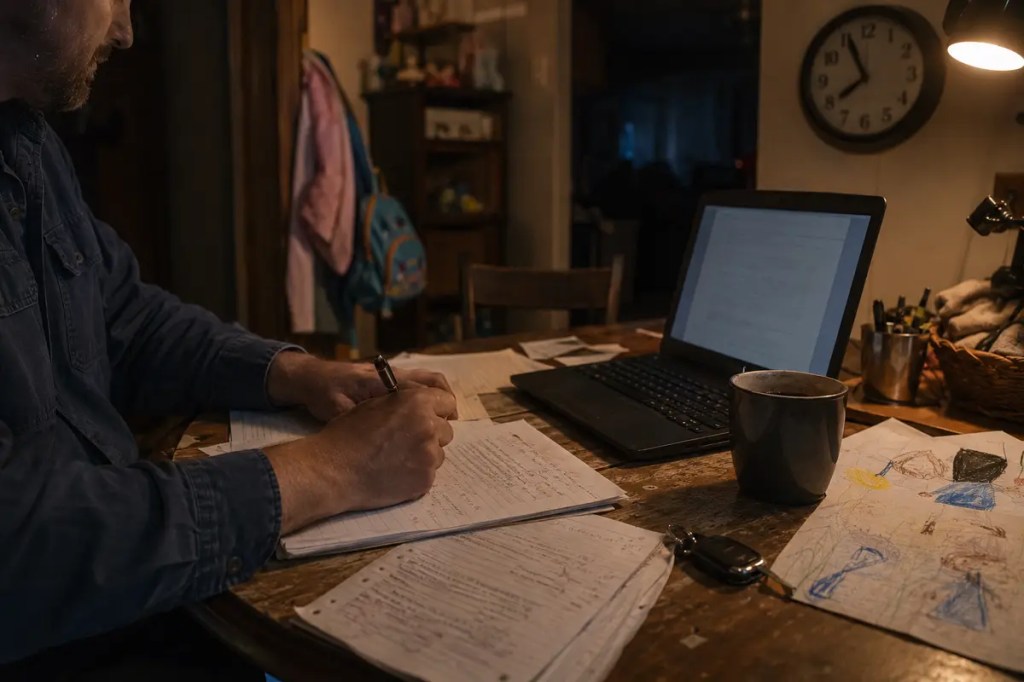
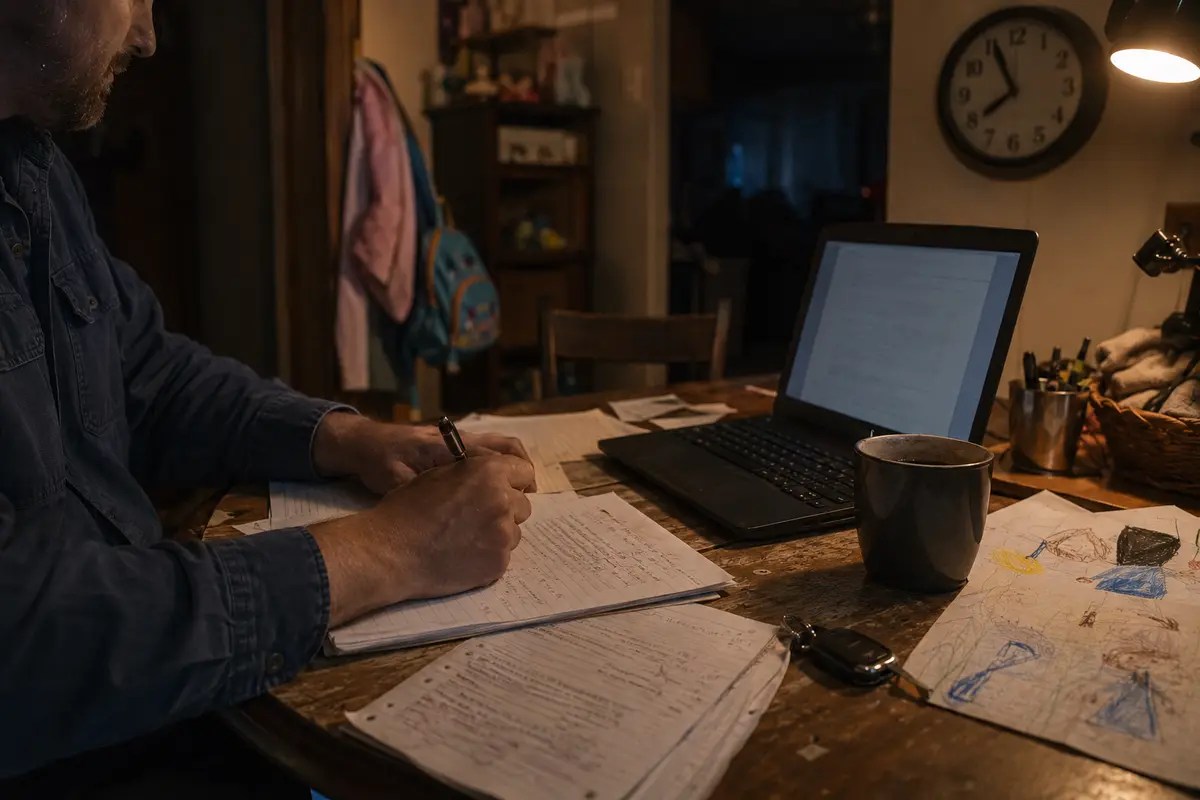
A tired father writing beside a laptop, cold coffee, work keys, and a child’s drawing late at night.
The sessions that build a book rarely feel important while they are happening.

The book was built during sessions that rarely felt important while they were happening. A child needed something. Work followed me home. My attention arrived late and left early. I didn’t usually feel like an author. I felt like a tired man trying to move one sentence a little closer to the truth.

This isn’t a victory lap. Finishing a book didn’t turn me into a model of discipline. If anything, it exposed how many other things I have postponed while waiting for the right mood or the right version of my life. We all have a small graveyard of intentions labeled “when things settle down.”

Things rarely settle down. They just change what they are loud about.

Fifteen hours a week isn’t easy when work is demanding and children are growing up in real time. And quantity does not guarantee quality. Consistency cannot replace judgment, revision, or honesty. It simply gives those things something to work on. Zero produces nothing to revise.

We often say we don’t have time when we mean we do not have time that arrives preapproved—free of guilt, interruption, or sacrifice. Protected time seldom presents itself. It has to be claimed from a phone, a television, another chore, or the endless appetite of other people’s urgency.

The goal isn’t to become consumed by the work. It’s to stop requiring the work to consume you before you take it seriously.

A finished manuscript resting among work keys and children’s school items on a kitchen table at sunrise.
A small, defended part of the week can eventually leave evidence.

At the end of one week, the protected fraction may look almost meaningless: a few hundred words, a rough page, one idea you aren’t sure you can use. At the end of forty weeks, it may be the only part of the year you can hold in your hands.

A life doesn’t always change because you found more time. Sometimes it changes because you stopped letting one small piece of it belong to everything else.

The Uncertainty of Family History

In Liliana Colanzi’s essay “Tropical UFOs,” her mother and uncle agree that something extraordinary happened above a river in Bolivia. A spaceship came down. Strange light covered the witnesses. Then it disappeared toward the trees.

They disagree about almost everything that should be easier to remember.

Her uncle says they were children. Her mother remembers being married and returning from a funeral with several relatives. He remembers an abduction. She remembers an object hovering above them.

The other witnesses are dead.

That means the argument will never be settled—not because the event was too strange, but because the people who could compare the stories are gone.

Two people watch an unexplained light hovering above a tropical river at night.

The UFO is almost beside the point. Families lose track of ordinary facts all the time.

Someone I know grew up believing she was descended from a Cherokee chief. That was the story her mother had given her. Not merely Cherokee, either. A chief. Family legends rarely suffer from a lack of promotion.

Years later, the subject came up at a family reunion. Her aunt had heard a different genealogical story. The branches didn’t connect the same way. The confidence remained; the facts had started moving.

Eventually she took a consumer DNA test. The ancestry estimate came back entirely European.

Somewhere between her mother’s story, her aunt’s version, and the laboratory, the Cherokee chief quietly left the family tree.

A DNA estimate can’t perfectly reconstruct every person who ever contributed to a family. But it made one thing difficult to deny: the story she inherited as fact was not nearly as settled as it had sounded.

That doesn’t necessarily mean her mother lied. More likely, her mother repeated what somebody had once told her. Sincere people can pass along inaccurate stories with tremendous confidence. Family history often travels farther on certainty than it does on evidence.

Two relatives compare old photographs and genealogy papers during a family reunion.

That’s part of what makes writing about small towns and family history both important and dangerous.

Places changed by water, time, and people leaving do not preserve themselves in clean transcripts. They survive in kitchens, church foyers, old photographs, property lines, and stories told by people who assume everyone already knows the names.

One person remembers the year. Another remembers the weather. Somebody insists the truck was blue. Somebody else is equally certain it was green. The event may be real while the details refuse to stand still.

Writers feel pressure to fix that.

Readers prefer a date. They want one truck, one route, one version of what happened. Uncertainty can look like weak research, so the temptation is to choose the account that sounds best and sand away the disagreement.

But making the past neater does not make it truer.

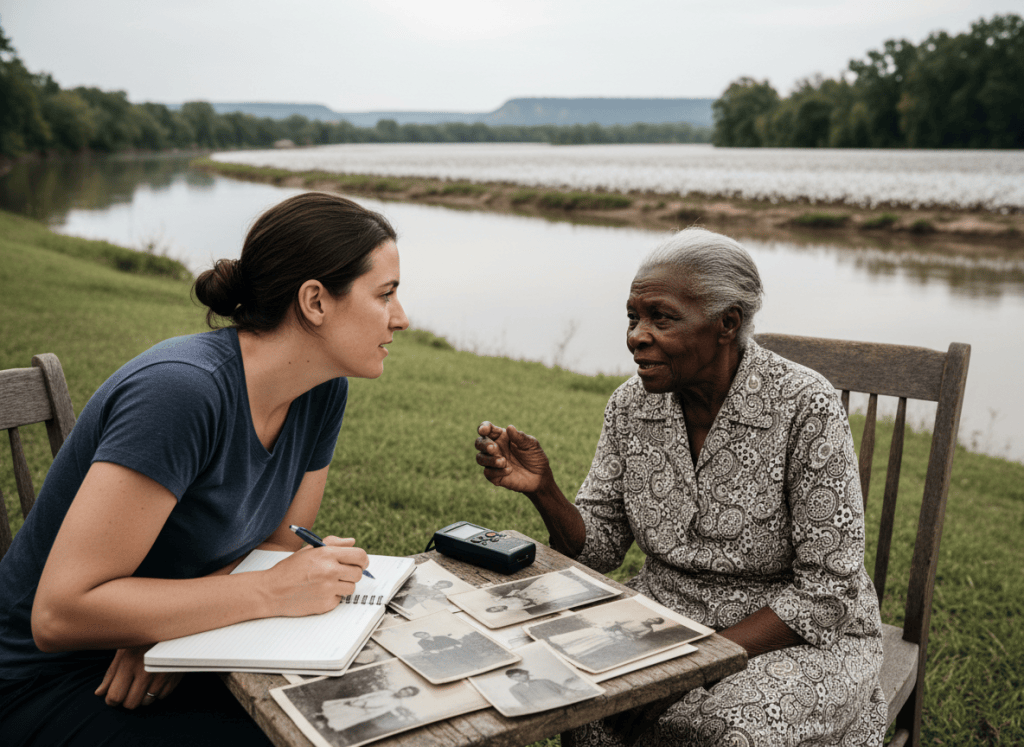
A writer records an older person’s memories beside the Arkansas River near Carden Bottoms.

Sometimes the disagreement is the history.

The honest version may be: She remembered it this way. Her brother remembered it differently. No one is left who can tell us which one was right.

That sentence preserves more than doubt. It preserves two people. Their memories. Their loyalties. The different meanings the same event gathered as they carried it through life.

The work, then, is not only collecting stories. It’s collecting the edges around them. Who told you? Were you there? What part do you know, and what part did you hear? Did anyone else remember it differently?

Ask while someone can still answer.

Record the pause before the answer too.

Because when the last witness dies, we don’t simply lose another version. We lose the chance to measure one memory against another. What remains may still be beautiful, useful, and worth passing down. It just should not be dressed in a certainty it no longer possesses.

Sometimes “I don’t know exactly” is not a failure of storytelling.

It is the last truthful sentence available before silence.


Source note: Inspired by Liliana Colanzi’s “Tropical UFOs,” translated by Chris Andrews and published by Southwest Review.

Don’t Let Your Child’s Dream Become Somebody Else’s Business Model

Eighty dollars once bought a season.

Eight thousand dollars now buys a year.

That was the contrast in a Morning Brew story about youth sports: one Florida parent remembered paying $80 for recreational sports during her childhood. She now spends about $8,000 each year on club baseball for her 12-year-old son.

Those aren’t identical experiences, of course. Recreational ball and club ball (or travel ball, round these parts) promise different things. That difference is where the business model lives.

Parents watch children play baseball beneath the lights of a modest small-town Arkansas ballfield.

I understand the parent’s side of it.

I am a father. I have watched my children play sports, and I know the desire to give them every honest chance. If one of them possesses real ability and the willingness to work, I don’t want money, geography, or my own hesitation to become the reason a door closes.

I also work in sales and marketing, so I know what happens when fear can be connected to a purchase.

Youth sports has found one of the most powerful fears a parent carries: What if my child could have become something, and I was the one who said no?

Once that fear takes hold, we are no longer buying a tournament, a private lesson, or another uniform. We’re buying protection from future blame. The next level always seems to sit behind another registration fee, another hotel weekend, another instructor, or another facility.

The Aspen Institute found that family spending on a child’s primary sport rose 46 percent from 2019 to 2024. Its researchers estimate that parents now spend more than $40 billion each year on youth sports. That does not include everything schools, municipalities, facilities, and sponsors spend around them.

There is too much money involved for parental anxiety to remain an accidental byproduct.

A parent watches a child train inside an expensive elite youth-sports facility filled with commercial signals.

This isn’t an argument against travel teams, serious coaching, or private instruction. Some children want the harder competition. Some coaches change lives. Good training can sharpen talent, build discipline, and introduce a child to opportunities that a small town can’t provide on its own.

The question is not whether the expensive option is always bad.

The question is who still owns the dream.

Is it the child who wants to play? Is it the parent who has invested enough money to need the sacrifice to mean something? Or is it the company promising that one more purchase will keep the future open?

The answer can change quietly.

A child begins with a glove, a ball, and the pleasure of getting better. Then adults add rankings, exposure, specialized training, highlight videos, travel calendars, and the language of scholarships. Eventually, a ten-year-old can feel responsible for producing a return on an investment he never asked anyone to make.

That’s too much weight for a game to carry.

Parents need to be honest about more than the bank account. We should notice whether our child still talks about playing or only about performing. We should ask whether the extra work belongs to his ambition or our anxiety. We should be willing to hear that a dream has changed without treating every dollar already spent as a contract he or she must keep honoring.

A father and child play catch alone on a simple local baseball field at sunset.

Supporting a dream sometimes costs real money. It also requires restraint. Every possible future cannot be purchased, and trying to buy them all can take something from the life the child is living now—rest, friendships, family time, freedom to try another sport, or the right to discover that this was something he loved but not something he wanted to become.

Aspiration is not the enemy. Neither is business. But when an industry profits from convincing parents that ordinary participation is failure, somebody has to protect the child from becoming the product.

A father’s job is not to purchase every possible future; it’s to keep the present game from being taken away from the child.

Sources: Morning Brew: “Youth Sports Brew”; Aspen Institute Project Play: Family spending rises 46%; Aspen Institute Project Play: Private equity and youth sports

Thursday Night Football and Shipping Containers

Months before the Los Angeles Rams crossed the Pacific, a shipping container was already making the trip.

Inside were game-day drinks, supplements, food, and supplies. The kind of things nobody in the stands would notice unless they are missing.

The NFL’s first regular-season game in Australia will be played under the lights at the Melbourne Cricket Ground. That is the part made for television: the uniforms, the crowd, the opening kick, and the announcer reminding us how far everybody traveled.

The less glamorous part began 218 days earlier.

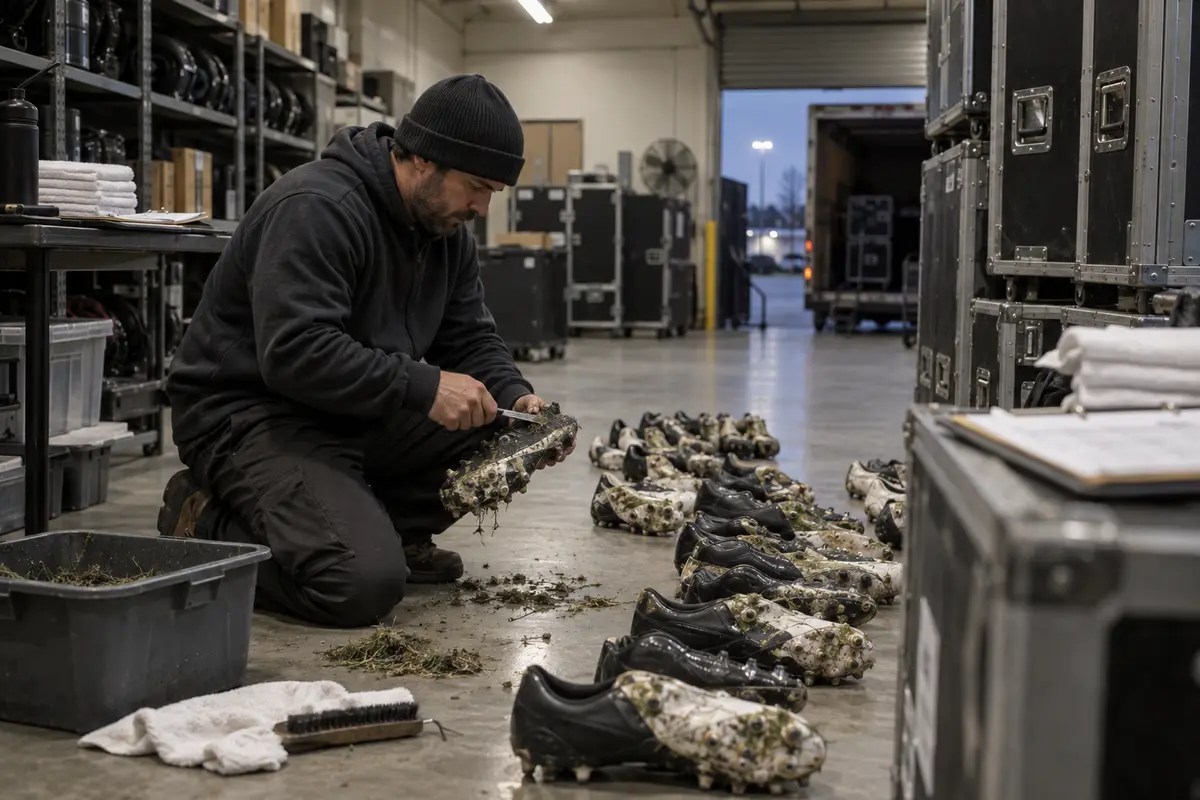
The Rams had to move roughly 25,000 pounds of equipment in 90 trunks. Every trunk needed a manifest listing what was inside, what it was worth, and where it came from. Australian biosecurity rules meant the cleats had to arrive free of dirt, seeds, and grass. Somewhere, while the players prepared to play football, an equipment manager was scraping yesterday’s practice field from the bottom of somebody else’s shoes.

A shipping container carrying game-day supplies crosses the Pacific months before kickoff.

That may be the most honest picture of leadership I have seen in a while.

We like the visible moment. We celebrate the touchdown, the sale, the finished book, the family picture, and the number at the bottom of the report. We rarely ask who made sure the right cord, form, meal, key, or backup plan was in the room when the moment arrived.

The game isn’t won in the shipping container. The players still have to play. Preparation can’t guarantee an outcome.

But a great many things can be lost there.

An equipment manager removes every trace of dirt and grass before the cleats can clear customs.

At a dealership, the customer sees the delivery photo. He sees the clean vehicle, the keys in his hand, and the smile that gets posted online. He doesn’t see the inventory checks, the trade appraisal, the lender calls, the paperwork corrections, the detail department, the fuel, the insurance verification, or the person who caught the missing signature before it became tomorrow’s problem.

When those pieces work, the final moment looks easy. That’s the strange reward of good preparation: it often removes the evidence that it was necessary.

Leadership is not only performing well when the pressure arrives. It’s reducing the number of emergencies everyone else will have to survive. Pressure may reveal preparation, but it rarely replaces it.

Before the doors open, a dealership manager prepares the paperwork, keys, and vehicle behind the delivery photo.

Fatherhood contains the same invisible work. Children see Christmas morning, not the calendar, sacrifice, and quiet worry behind it. They see the uniform ready for practice, not who remembered to wash it. They see that somebody showed up, not the rearranged day that made showing up possible.

That doesn’t mean children owe us applause. Love becomes something uglier when every sacrifice is presented as an invoice. The point is not to make people feel guilty for enjoying the moment. The point is to respect the work required to make good moments dependable.

Writing is no different. A reader sees the finished essay, not the notes carried around, the weak opening deleted, or the paragraph that had to be rebuilt because it sounded better than it was true. The published piece is kickoff. Most of the real contest happened when nobody was watching.

There’s a temptation in responsible lives to resent that invisibility. We want somebody to notice the early morning, the second check, or the problem prevented so completely that it never became a story. Sometimes they will. Often they won’t.

Do the work anyway.

The crowd will remember who caught the pass. The customer will remember the keys. The child will remember the morning. But somewhere before each visible moment was a person nobody applauded—the one who packed what everybody else would need before they knew they needed it.


Source note: Inspired by Morning Brew’s reporting on the Rams’ Australia game and Sports Illustrated’s inside account of the team’s 15,000-mile operation.

Potential Has an Undefeated Record

There is a moment in writing when the work stops belonging only to you.

For a long time, the book was a collection of notes, half-finished ideas and sentences scattered across more files than any responsible adult should create. It was mine in the safest possible way. I could work on it when inspiration showed up, ignore it when life got loud and still tell myself I was writing a book.

Then I finished it.

That should have felt like relief. Instead, I stared at the file and realized finishing had created an entirely new problem.

Somebody else could read it now.

As long as the book remained unfinished, it could still be great. Not actually great, of course. Theoretical greatness is much easier. In my head, every unfinished chapter contained exactly the right words. Every joke landed. Every emotional moment struck the perfect balance between honest and self-indulgent. The imaginary reader closed the imaginary book and stared thoughtfully into the imaginary distance.

Reality is less cooperative.

A real reader can become bored. A real paragraph can fall flat. A real book can receive a very real shrug.

Potential has an undefeated record because potential never has to play the game.

The job you never apply for never rejects you. The person you never ask never says no. The business you never start never fails. The difficult conversation you never have never goes badly. The shot you never take cannot miss.

Of course, it cannot go in either.

That is the bargain we make when we protect our potential. We avoid one outcome by eliminating both.

I have always believed I was capable of more than my circumstances showed. That belief has helped me survive difficult seasons. It has also occasionally become a hiding place.

If the better career, finished book or improved version of myself remained somewhere in the future, I could keep believing it would be exceptional. Reality had not measured it yet. I was not failing. I was simply waiting for the right time, the right opportunity, the right energy or the right alignment of the planets.

Fear owns a surprising number of respectable outfits. Sometimes it dresses like preparation. Sometimes it calls itself patience. Sometimes it brings a legal pad, asks seventeen responsible questions and convinces us that one more round of thinking is the same thing as progress.

Preparation matters. Timing matters. Some decisions deserve patience.

But eventually we have to ask whether we are preparing to act or preparing an explanation for why we never did.

When I sent the manuscript to its first readers, I felt exposed in a way that surprised me. These were not strangers on the internet. They were people whose opinions mattered. They would see the seams. They would know where I had reached for something and missed it.

They might also find something useful.

That possibility only became available when I stopped protecting the other one.

The book is called A Nobody’s Guide to Self-Help. The title is partly a joke and partly a confession. I am not offering the wisdom of a man who conquered the world. I am offering a few landmarks from a man who has walked into enough holes to recognize some of them in the dark.

Writing it taught me something I probably should have learned sooner: evidence is less flattering than potential, but it is far more useful.

Evidence can be improved.

You can revise a bad paragraph. Learn from the interview you did not ace. Adjust the business after the first month. Recover from an awkward conversation. Practice the shot you missed.

Potential cannot be improved because it refuses to become anything.

So this is not a motivational demand to quit your job by lunch, empty your savings into a dream or confess your love to somebody who has made it very clear they would prefer you remain several counties away.

It is a smaller challenge.

Identify one thing you have kept safely theoretical. Then find the smallest honest action that would allow reality to touch it.

Send the email.

Submit the application.

Share the draft.

Ask the question.

Take the shot.

You may miss. I may too.

But undefeated is not the same thing as accomplished.

What part of your potential are you protecting from the possibility of becoming evidence?

Dolly Parton’s Legacy of Books and Empowerment

We tend to talk about legacy as if it is something we build with our own two hands.

A business. A book. A name on a building. Enough money left behind that our children do not have to struggle the way we did. Then somebody leaves behind something larger than anything he could have built himself.

When Dolly Parton died on August 25, I learned something about her that I didn’t know. And it had nothing to do with rhinestones, pearls, and country music. It had everything to do with her father.

Robert Lee Parton could not read. Dolly called him the smartest man she had ever known. She also believed his inability to read kept him from fulfilling many of his dreams.

So she built the Imagination Library in his honor. What began in one Tennessee county grew into a worldwide program that mails a free book every month to more than three million children. Before he died, her father told her it was “probably the most important thing I had ever done.”

Not the songs. Not the awards. Not the money.

The books.

A boy traces a page in an open book while his father's hand rests beside him at a wooden kitchen table.

I think about that because one of my boys has had to learn that difficulty with traditional reading is not the same thing as a lack of intelligence. School can turn one narrow skill into a courtroom exhibit. A hard page starts to feel like evidence. A slow test starts to sound like a verdict.

It is not.

A child can struggle to pull meaning from a page and still understand people, patterns, consequences, machines, humor, or the quiet things happening in a room. Intelligence does not always arrive in the format a classroom finds easiest to grade.

That does not mean reading is unimportant. It means shame is a lousy teacher.

As a father, my job is not to pretend the hill is flat. The hill is real. There will be assignments, forms, instructions, applications, and a thousand other places where the written word matters.

My job is to keep him from believing the hill is the whole world and that he is responsible for crossing it the same way everyone else does.

That may be one of the hardest parts of parenting. We want to give our children confidence, but confidence cannot be built from lies. We cannot tell them everything will be easy. We can tell them that hard is not the same as impossible, and struggle is not the same as stupid.

Dolly’s father could not hand her literacy. He handed her intimate knowledge of what happens when a capable person is locked outside a door. She spent the rest of her life mailing keys.

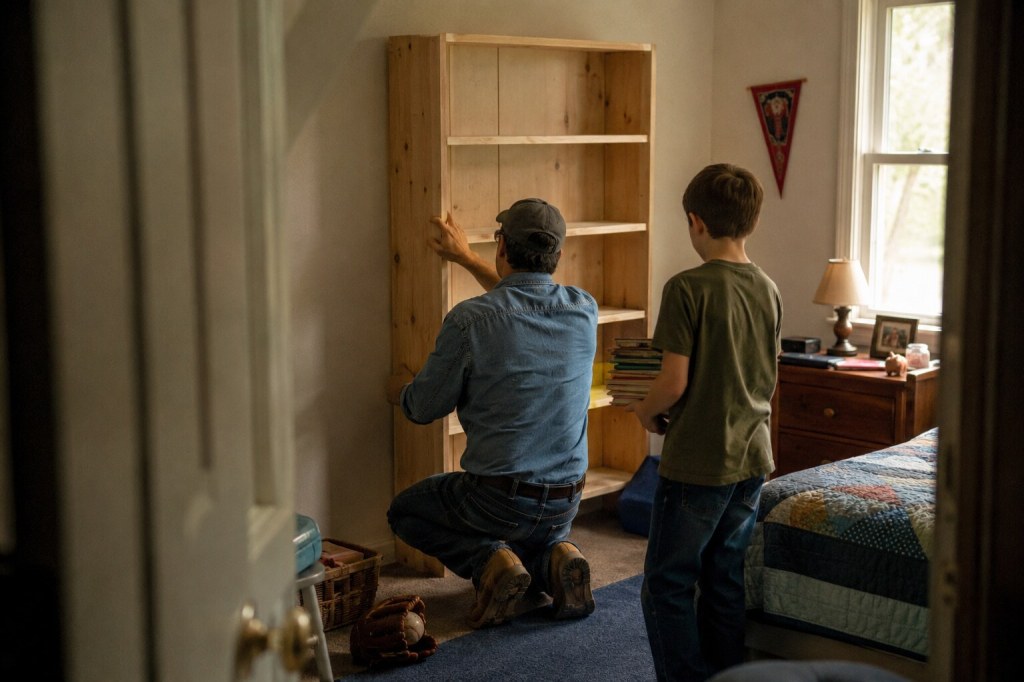
A father installs a wooden bookshelf in his son's bedroom while the boy waits with a stack of books.

We usually talk about what children inherit in visible terms: our eyes, our temper, our last name, our property, and, if genetics is feeling especially generous, the best of ourselves.

But children inherit our unfinished business too.

Sometimes they inherit the courage we modeled. Sometimes they inherit the wound we could not heal. Sometimes our limitation becomes the raw material they use to build something neither of us could have imagined.

That does not make the limitation good. It does not romanticize the hurt or excuse the world for failing to recognize somebody’s intelligence.

It simply means love can refuse to waste pain.

I don’t have to possess every gift my children will need. I won’t understand every way their minds work. I will not always know the right book, the right teacher, or the right sentence to say when frustration settles over the kitchen table.

But I can keep building shelves.

A father carrying boards and tools walks beside his son carrying a book near a rural roadside library at sunset.

I can protect curiosity while skill catches up. I can separate effort from worth. I can remind a boy that a page is something to work through, not something allowed to define him.

Maybe that is legacy.

Not proving that we had every answer, but making sure our children never confuse the answers we lacked with the limits of who they can become. A father does not have to possess every gift to help awaken it in his children.

The man who could not read helped build a library anyway.

Embracing Failure: Lessons from Ted Williams

I should be more consistent with writing. I don’t usually sit down and think of a particular topic to write about. Most of the time, it just comes to me. Just the other day, I was thinking about “failure.” I realized that many things I write about have failure as a central theme. I don’t consider myself an expert on anything, but if I were to bestow that title on myself in some regard, it would be “Master of Failing.”


To be honest, I’m not even mad about it. It took a while to learn, but once I figured out that failing was an important part of growing, I decided to embrace it. I’m not saying that I have never made the same mistake twice, but I feel like most of my failures are unique, and I use them to fuel growth and development.


I’ve been in the car business for almost 20 years. When you are a professional salesperson, failure is a constant factor. Even the best in the industry don’t sell to every customer they talk to. A GOOD salesperson should expect to close 30%- 35% of the customers they interact with. To put it in perspective, if a baseball player gets a hit one out of every three times he goes to the plate, he’s considered a Hall of Famer. Similarly, if a salesperson closes a sale with one out of every three customers, they’re doing exceptionally well.


That means that the best players in the game’s history fail two out of every three times they have an at-bat.


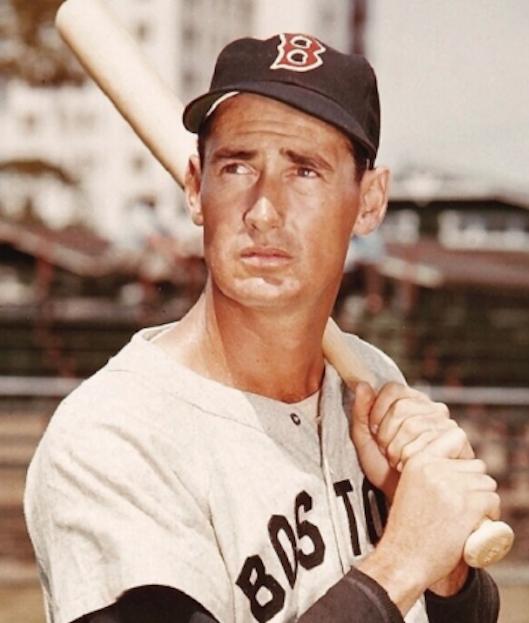
Today, I’m returning to 1941, when Ted Williams had arguably the best season at the plate in baseball history. He finished the ’41 season with a batting average of .406 with 37 home runs and 120 RBIs. To provide context, .200, the Mendoza line, is considered the low-end threshold for professional ball players. The average batting average of Hall of Famers is .303.


Williams played in 143 games that season and had 456 at-bats. But the breakdown of three particular stretches of that 1941 season interests me the most.


On April 30th, Williams entered the game hitting .462. Over the next four games, he hit .182, dropping his season average to .310.


By June 21st, he had battled his way back up to .415. But he only hit .318 over the next 21 games, dropping that average all the way down to .393.


His average peaked again at .413 during the heat of the pennant race in early September. But a .292 stretch over the next 17 games saw it drop right to the .400 mark near the end of the season. Entering the last day of the year, he was so close to the .400 mark that a bad day at the plate would have kept him from reaching that sacred number.


This is important because even though his season as a whole is considered extraordinary, not every day, or even week, was even considered average. But during those subpar stretches, Ted Williams didn’t panic. He didn’t change up his swing. He didn’t stay down in the dumps and stop coming to work. He showed up every day, stepped inside that chalk-outlined box, and did his job to the best of his abilities. And he let the chips fall where they may.


The most significant lesson I’ve learned about failure is that it’s interwoven into the fabric of success. It’s more about ‘fall, learn, grow’ than ‘pass or fail.’ These three unremarkable stretches of Ted Williams’ historic season wouldn’t impress anyone. But his resilience and determination during those times are just as, if not more, important than his successes.


We get so caught up in results that sometimes we lose focus on the processes. Instead of getting up and walking out of the pit of despair, we let ourselves get so deep that we can’t even climb out. We let our losses define us even though we may be on the cusp of a breakthrough. Our inactivity lets the tide sweep us back to the starting line when riding the wave will get us closer to our destination.


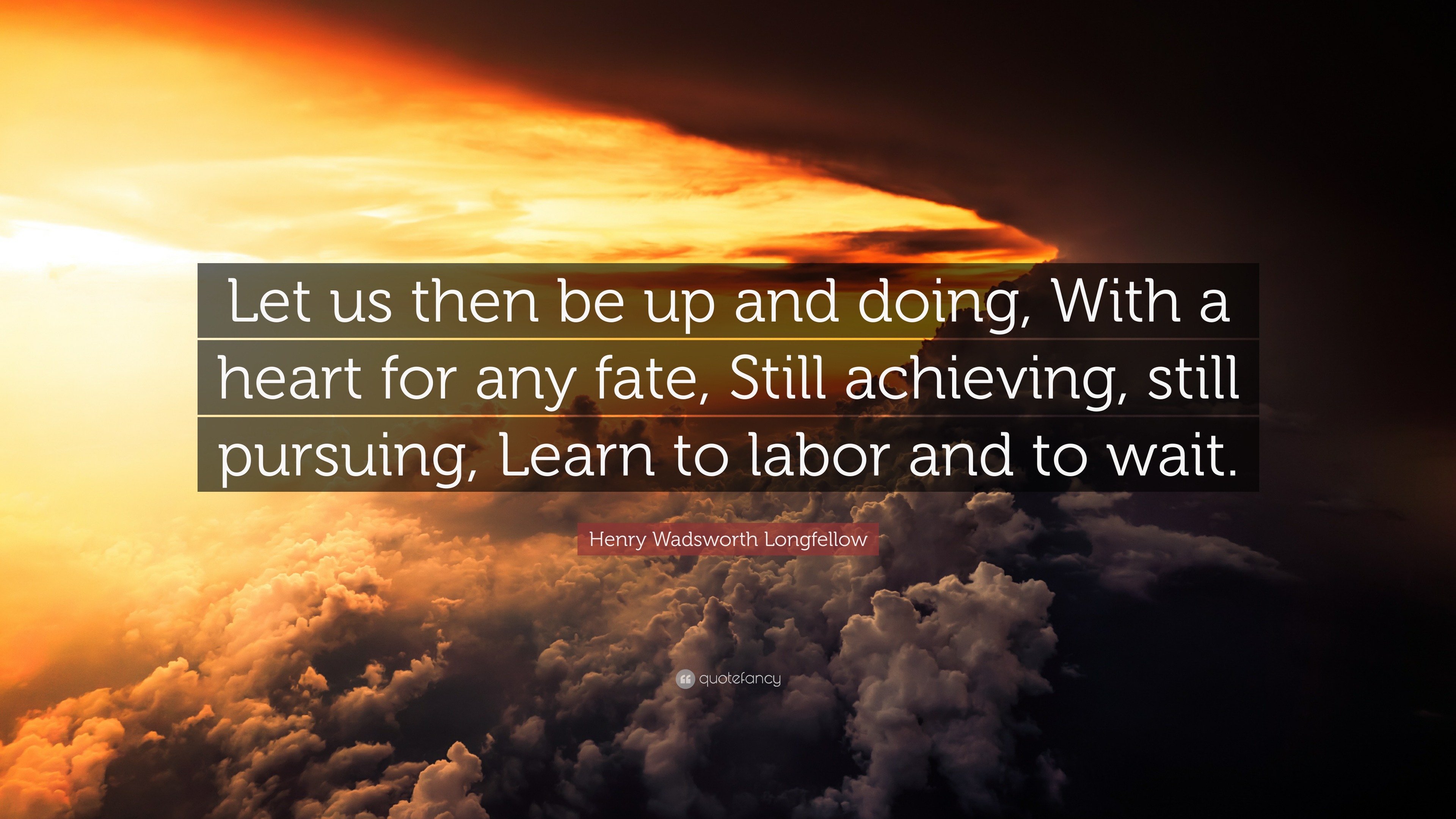
I used to tell kids when they’d ask me a question, “I wish I had it all figured out.” I don’t tell them that anymore because it isn’t true. I’m glad I don’t have it all figured out. My next failure is always right around the corner, and I’m excited to see what revelation it will lead to. I try (emphasis on “try” ) to be consistent and open-minded while keeping a positive attitude. In the words of the great poet Henry Longfellow: “Learn to labor and to wait.”


Show up. Stay the course. Keep your head high. Learn. Don’t quit. Don’t ever quit.