The Real Difference: Charisma vs. Character

Some people can control a room beautifully but can’t be trusted alone with making a decision.

You’ve probably met one. They remember names, hold eye contact, tell a story at exactly the right moment, and make the people around them feel smarter and more hopeful than they did before they arrived. By the time the coffee cools, the room belongs to them.

That is a real ability. It’s also incomplete evidence.

Charisma answers one question: How do people feel while you are speaking? Character answers a harder one: What becomes true because they trusted you?

I’ve spent most of my adult life in sales and leadership, two places where charm has a scoreboard. Good communication matters. A customer should feel comfortable asking a question. An employee deserves a leader who can bring clarity and hope into a difficult day. Eye contact, timing, confidence, stories, and good questions can all be learned. Learning them is not dishonest. Warmth can be a genuine form of service.

But the appearance of care can be learned faster than responsibility.

A warmly lit automobile showroom where a man speaks to an attentive group.

A salesperson can make a customer feel understood and still disappear when the paperwork is signed. A manager can fire up a room on Monday and avoid the truth when Friday brings bad news. A person can speak beautifully about faith and still use influence carelessly when there is no microphone nearby.

The same danger exists in relationships. It’s possible to know how to make another person feel special without knowing how to be honest, consistent, or responsible for the effect you have on them.

But charisma is not always a disguise.

I once dated a woman who had an unusual gift. Whoever she was speaking to—regardless of title, money, or station in life—felt like the most important person in the world. She listened in a way that made it seem as if the room had emptied around you.

That could have been charm alone. What convinced me otherwise came later.

Long after our relationship ended, she would reach out from time to time to ask how I was and remind me that she was still in my corner, rooting for me. There was nothing left to win. No audience. No advantage. Her care had outlived its usefulness.
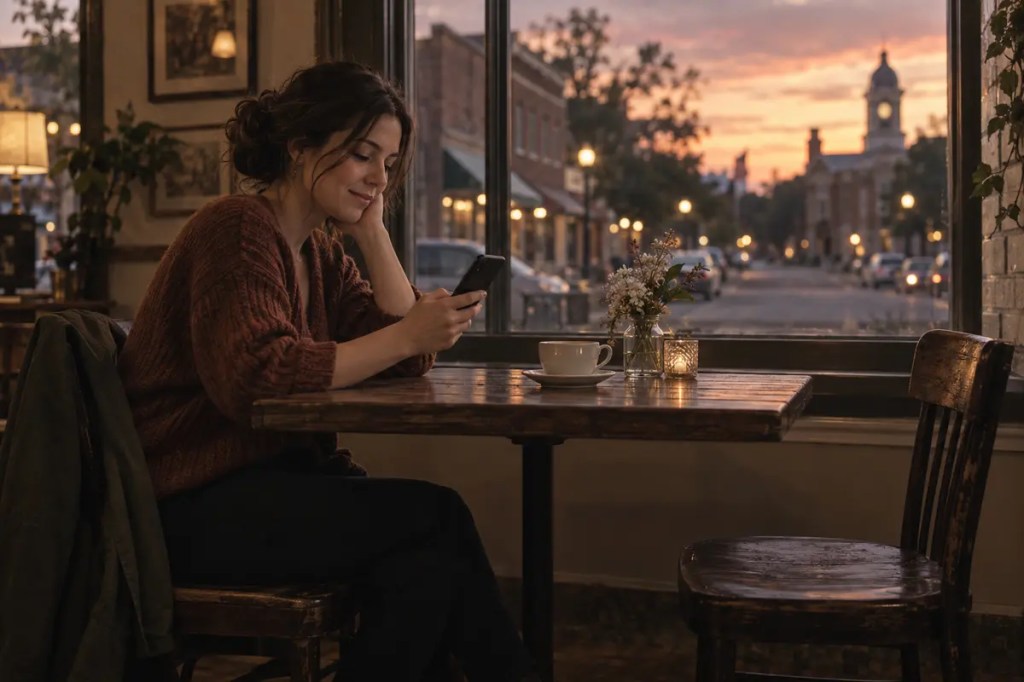
A woman sends a quiet check-in message from a café at dusk.

That doesn’t mean every relationship between two good people should continue. Goodness doesn’t erase incompatibility, history, or the need for boundaries. It simply means her warmth was not manufactured for a result. The attention she gave people was connected to something sturdier than technique.

Manufactured sincerity asks a question to find leverage. Genuine presence asks because the answer matters.

We should not become suspicious of every charismatic person. Cynicism can be as lazy as seduction. Some people are naturally gifted with presence; others work to communicate better. The skill itself is not the moral issue. Character decides what the skill serves.

The test usually comes after the impressive part is over. Was the promise kept? Was the bad news delivered honestly? Was the phone call returned when there was nothing else to sell? Did the leader protect the absent person, admit the expensive mistake, and restrain the power he could have used for himself?

Character leaves evidence outside the spotlight.
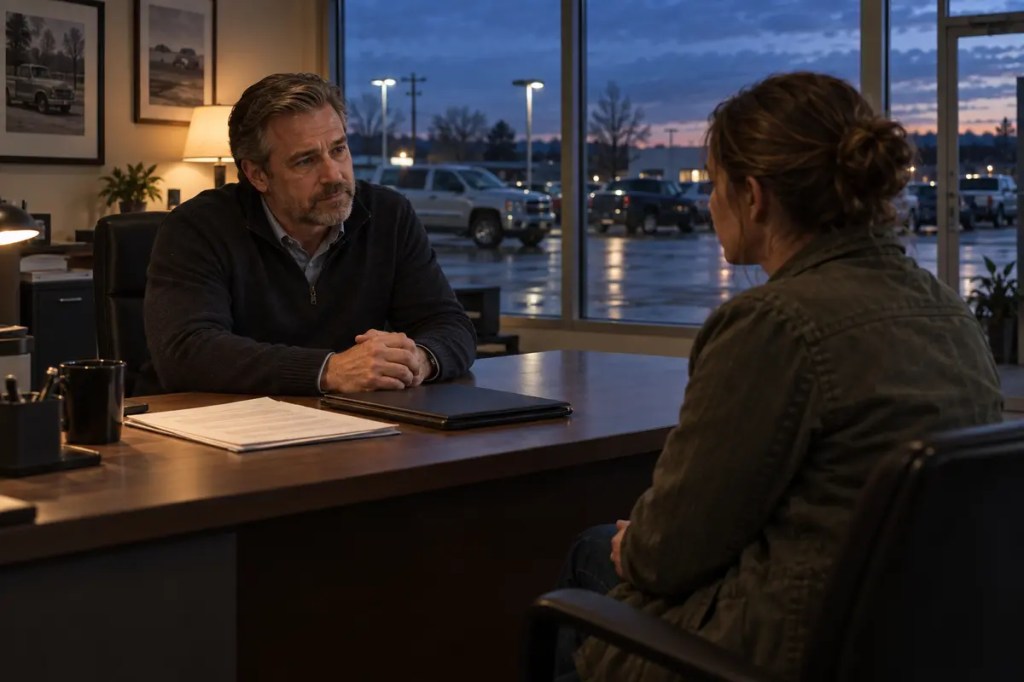
A manager has a quiet, honest conversation in an almost-empty dealership at dusk.

I know how easy it is to confuse a good response with proof of a good heart. A successful meeting, a relieved customer, an energized team, or a kind comment from a reader can all feel like confirmation. But being convincing and being worthy of belief are not the same accomplishment.

If I want to know what kind of person I am becoming, the better question is not whether people enjoyed hearing me speak. It’s whether my family, coworkers, customers, and friends are safer because I told them the truth and kept my word.

Charisma may open the door, but character decides what you do after you are invited inside.


Source note: Inspired by Deepstash Daily’s summary of Robert Greene’s The Art of Seduction.

Returning Is Not the Same as Going Back

Seconds before Céline Dion sang the first note of her first full concert in six years, the stage probably looked much like it always had. Lights. Musicians. A waiting crowd. A microphone in the place where a microphone belongs.

But six years were standing beside her.

Illness had interrupted the life she knew. The return required years of physical and vocal work, and the road was longer and rougher than she expected. When she finally began, she became so emotional that the audience had to help carry the opening song.

That’s the part the word “comeback” usually leaves out.

A singer stands beneath a spotlight in the silent moment before beginning a return concert.

Comeback is a clean word. It makes absence sound like an intermission. It suggests someone stepped away, handled a problem, and returned to the same stage as the same person, ready to pick up exactly where she left off.

Real life is seldom that tidy.

Illness changes the person inside the body. Grief changes the person who walks back into the house. Divorce changes the person who tries to trust again. Parenthood changes the person who returns to ambitions he once imagined pursuing without interruption.

Even good change has a cost. We don’t pass through six years—or six months, or one terrible week—and remain untouched.

For a long time, I thought rebuilding meant restoring. I imagined there was an earlier version of my life sitting somewhere intact, waiting for me to find the right road back to it. If I could recover the right habits, confidence, relationships, or sense of direction, perhaps everything would feel familiar again.

But rebuilding is not restoration when the original materials have changed.

A middle-aged Arkansas writer returns to an old manuscript at a desk shaped by years of family life and change.

When I returned to writing seriously, I was not retrieving some untouched version of myself who had merely been waiting for an available afternoon. I brought the years with me: work, fatherhood, disappointment, grief, mistakes, and questions I could not have written honestly before I had lived them.

Some of those experiences reduced me. They took confidence, energy, and certainty. I would not insult anyone’s pain by pretending every loss secretly arrives as a gift. Some things hurt because they are hard, and some absences remain absences.

Still, reduced capacity does not automatically mean a lesser life.

Sometimes the person who returns is better than the one who left—not because the suffering was good, but because he learned to stop wasting what is. He may be slower but more patient. Less certain but more honest. Less impressed by appearances and more grateful for ordinary days. He may finally know which promises deserve his strength and which expectations never did.

That is a better version, even if the measurements we usually celebrate cannot detect it.

The hard part is allowing the new person to build a life he can actually inhabit. We can exhaust ourselves trying to perform at an old pace, recreate an old relationship, recover an old identity, or prove the interruption did not change us. Sometimes healing begins when we quit treating change as evidence of failure.

A man enters a familiar room again, carrying the evidence of the life that changed him.

Returning may mean singing differently. Working differently. Parenting differently. Praying differently. It may require boundaries the former version of us never needed, gratitude he never understood, and the humility to accept help when the first note will not come.

A return is still worth celebrating. But not because it erased the years away.

It is worth celebrating because the person who lived through them stood in the light as he was—changed, grateful, uncertain, and willing to begin again.

You can return to the stage, the work, the faith, or the relationship—but you cannot return as the person who left.

Sometimes that is not the tragedy. It is the gift.

The Power of Asking the Right Questions

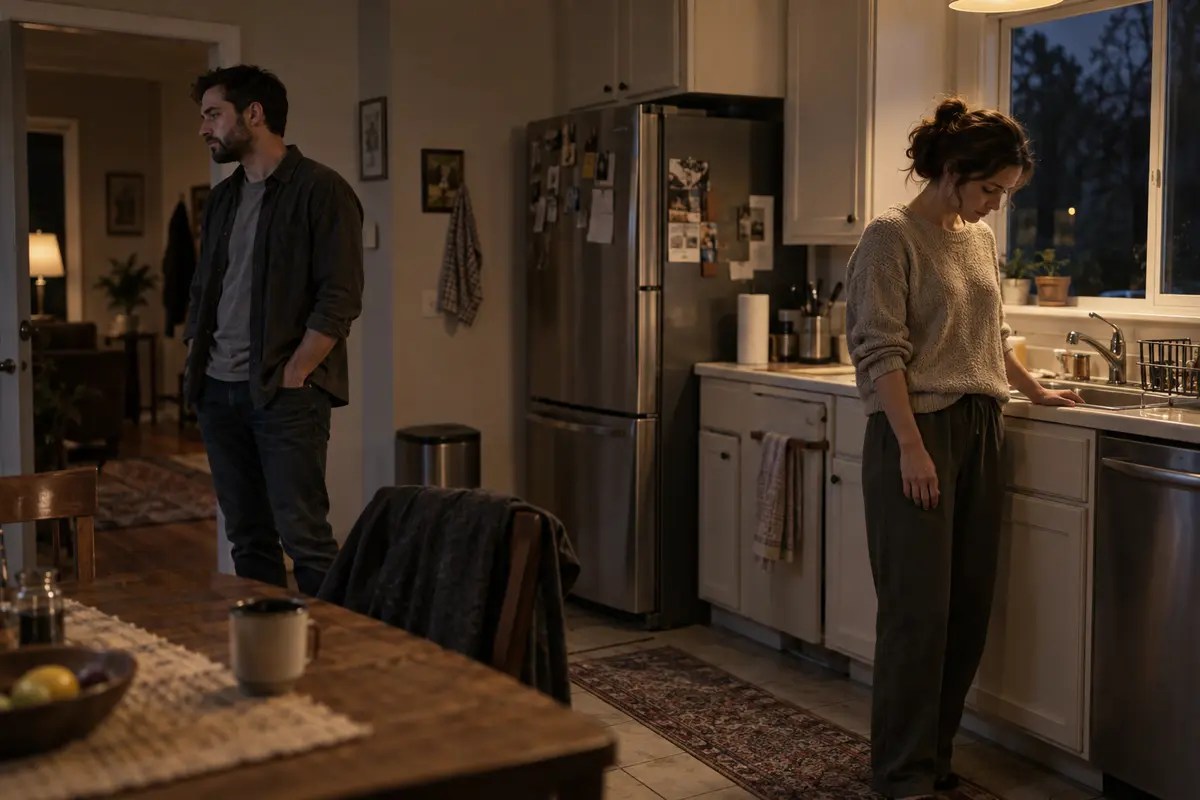
Two people can stand in the same kitchen, speak plain English, and understand almost none of each other.

One says, “Fine.”

The other hears, “The problem is settled.”

The first person may have meant, “I’m tired,” “I don’t feel safe explaining this,” or “You have already decided.” Both people know what fine means. Neither one knows what just happened.

The words were translated correctly.

The person was missed.

Two people stand apart in the same kitchen after their words fail to reach each other.

An email from ChatGPT recently promoted the ability to translate text, voices, and photographs, then use follow-up questions so the answer fits the moment. That is remarkable technology. But some of the most consequential translation failures happen between people who share a language, a workplace, a home, or even a last name.

The dictionary is nearly useless with certain sentences.

A child says, “I don’t care.” That may be indifference. It may also be fear posing as indifference because trying and failing would hurt more than pretending the thing never mattered.

As a father, I have not always heard the difference.

Sometimes I’ve answered the sentence instead of the child. I heard attitude and responded with correction. I heard laziness and gave a speech about effort. Maybe the correction was needed. Maybe the speech was true. But truth delivered to the wrong meaning still misses its target.

The better response is often a second question:

“When you say you don’t care, what do you mean?”

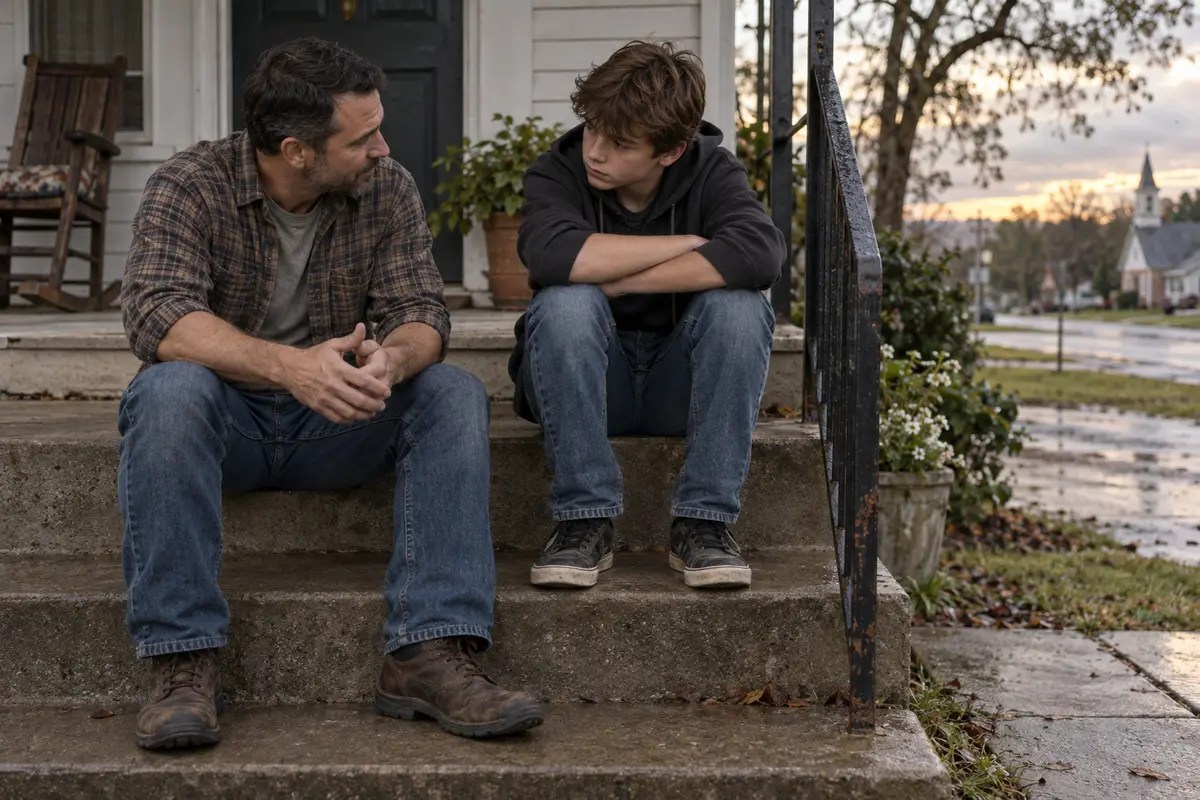
A father sits beside his teenage son, leaving enough room for the second answer to arrive.

Leadership has its own false translations.

An employee says, “I understand.” A manager may hear agreement, commitment, and a clear next step. The employee may only mean, “I understand that you are finished listening.”

That’s why it isn’t enough to ask whether someone understands. Ask what they believe the next step is. Ask what part still feels unclear. Inspecting what you expect is not only about numbers in a CRM. Sometimes it means checking whether the same conversation happened on both sides of the desk.

Salespeople learn this lesson every day—or they should.

“I need to think about it” can mean price. It can mean trust. It can mean embarrassment about money, fear of making a mistake, or a polite no. A bad salesperson translates the phrase into an objection to defeat. A better one asks, “What part would you like to think through?”

Not to trap the customer. To stop guessing.

A dealership manager sets his work aside and listens carefully to what an employee is actually trying to say.

Relationships are full of words that carry more than their definition. Later can be a promise or an escape. Respect can mean obedience to one person and consideration to another. Effort can mean intention, visible action, consistency, or sacrifice. I’m good can mean exactly that—or it can mean, “I don’t know how to ask you to stay.”

The danger here is mind-reading.

We should not treat every simple answer as a code to crack. Sometimes “fine” means fine. “No” still means no. Curiosity does not give us permission to replace another person’s words with the story we prefer.

The distinction is simple: mind-reading assigns a hidden meaning. Curiosity asks whether there is more meaning to hear.

I’ve been guilty of translating people into versions that were easier to manage. The child became an attitude problem. The employee became resistant. The customer became an objection. The person I loved became unreasonable.

Those translations saved time.

They also cost connection.

The second question is rarely efficient. It may extend the meeting, slow the sale, complicate the discipline, or reopen the conversation you hoped “fine” had ended. But people are not sentences to process. Listening is not finished when every word has been recognized.

A dictionary can tell you what the words mean. Real listening begins when you ask what the person meant.

Source: OpenAI Help Center, “ChatGPT Capabilities Overview”.

The River Keeps What We Throw Away

After the water level falls, a riverbank can look like a drawer somebody pulled open and forgot to close.

Mud gives back pieces of bottles, rusted metal, buttons, tools, fishing line, and things too worn to name. Some were lost. Some were thrown away. Most entered the water without ceremony because the person holding them had no reason to imagine a stranger studying them generations later.

Time changes the category.

An object can spend two hundred years as trash and become history the moment another hand lifts it from the mud.

A mudlarker searches the exposed Thames shoreline and lifts a small weathered object from the mud.

The Wall Street Journal recently reported that roughly 10,000 people are waiting for permits to search the River Thames. At low tide, mudlarks move through layers of ordinary London life accumulated across centuries. Roman pottery may rest near a modern vape. A coin, buckle, pipe stem, or broken piece of tableware becomes evidence that somebody once stood there, worked there, ate there, or dropped something he assumed was gone.

The river did not preserve any of it because it understood its importance.

A river doesn’t curate. It doesn’t separate heirloom from garbage, tragedy from routine, or the final possession of a dead man from something tossed aside after lunch. It carries, buries, breaks, and exposes. Some debris is only debris. Some of it poisons the water. The river remains indifferent to every meaning we eventually place upon it.

That may be what makes the lesson honest.

The Arkansas River moves past Dardanelle without announcing which parts of our lives will matter later. History is happening in kitchens, fields, sheds, boats, church foyers, and front seats while everyone involved still calls it an ordinary day.

Low water exposes mud, driftwood, and fragments of ordinary life along the Arkansas River near Dardanelle.

We are poor judges of what an absence will make valuable.

My mother died at sixty. Grief changed the weight of ordinary things. An old photograph could knock the breath out of me, not because the paper had changed, but because the world around it had. The image became a place where someone could still be found.

That happens with more than photographs.

A phrase repeated so often that nobody bothered to record it can become the sentence everyone strains to remember. A tool is just a tool until the hands that used it are gone. A familiar drive, an unnoticed laugh, or an afternoon spent doing nothing special can become precious only after repetition is no longer possible.

We usually preserve the ceremonies. We photograph birthdays, graduations, weddings, and holidays. We assume Tuesday will take care of itself.

But much of what grief asks us to recover was hidden inside Tuesdays.

This is also the problem facing anyone who tries to preserve family or local history. We search for the dramatic story and overlook the ordinary instructions packed inside a saying, the name written on the back of a picture, the reason a certain road was avoided, or the small object nobody has thrown away because it still feels connected to a person.

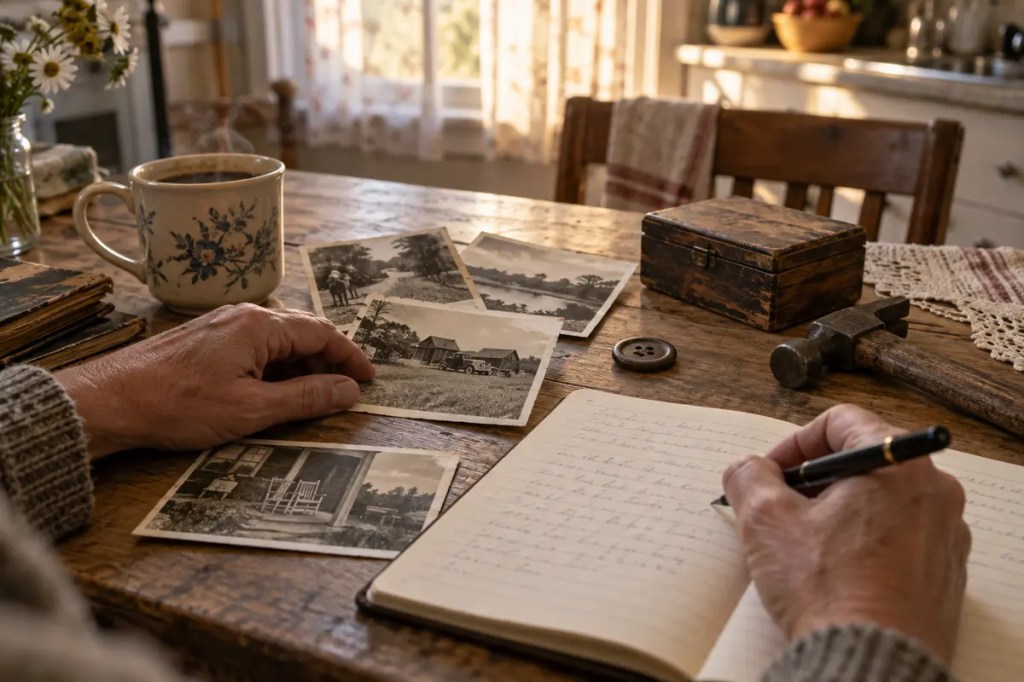
Family photographs, a worn button, and an old hand tool rest on a kitchen table while someone records their stories.

We cannot save everything. We shouldn’t even try. A life can’t become a storage unit where every receipt and broken object demands reverence. Attention is not the same as accumulation.

Still, we could become better witnesses to the life in front of us. We could ask the question while the person who knows the answer is still sitting nearby. We could write the name on the photograph. We could listen once more to the story we think we already know.

The mudlark looks at what another person discarded and sees evidence. Grief often does the same thing. It teaches us, too late, that the mundane was carrying more life than we noticed.

Maybe what we call history is often the present, rescued too late from our inattention.

Sources: Wall Street Journal: “Why 10K People Are Waiting to Search the Thames”; Wall Street Journal: “Why 10,000 People Are Clamoring to Dig in London Mud”

Inheriting Wisdom: The Power of Grandmother Sayings

My grandma used to tell me to be careful when I prayed for patience or courage. The Lord wasn’t likely to drop either one in my lap, according to her. He would give me opportunities to practice patience and put me in situations where they was required.

I understood the words when I was young, but I didn’t fully understand the warning. It sounded almost like she was telling me not to pray too hard. But what she meant was that character doesn’t arrive gift-wrapped. God may answer the prayer by handing you a hard person, a long wait, or a moment when doing the right thing makes your knees a little wobbly. That one little saying carried theology, realism, and a survival plan without ever turning into a sermon.

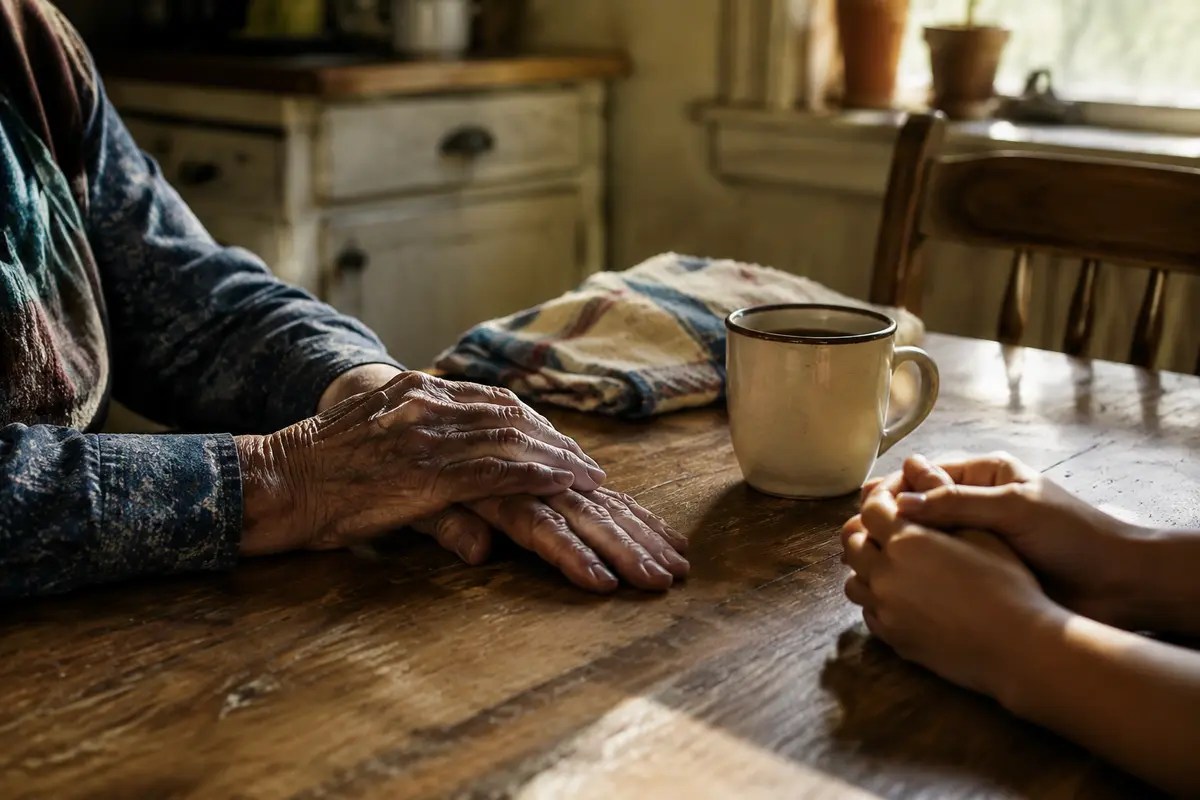
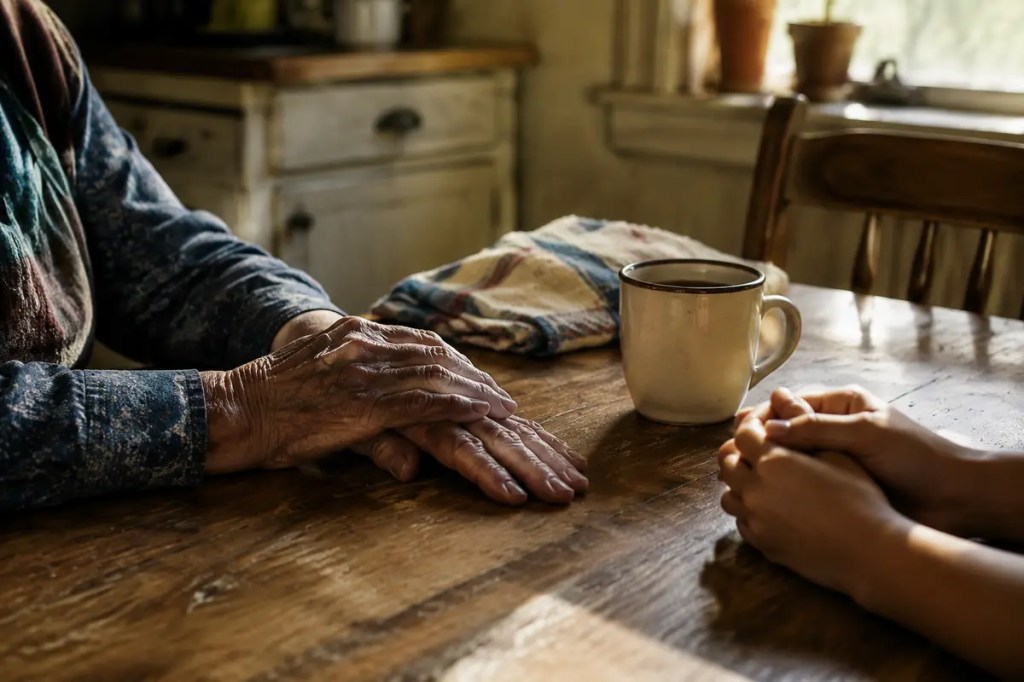
An older relative and a younger family member talking across a worn kitchen table.
The words matter. So does the voice that gave them weight.

I thought about her when I read an Upworthy collection of old grandmother sayings. One of them was, “Some days you’re the pigeon, and some days you’re the statue.” On the surface, it’s just funny. Underneath it, though, are crystal clear instructions: do not confuse a good day with permanent status, and do not mistake a bad day for your identity. Stay humble when you’re flying. Stay steady when you’re the statue.

Families around Dardanelle and Carden Bottoms didn’t always explain their worldview in essays. They packed it into warnings, teasing, Bible language, and comparisons that made sense if you had ever watched the river, worked a field, fixed a fence, or tried to stretch a dollar. A saying could correct foolishness without starting a fight. It could make bitter medicine go down with a laugh.

My grandmother grew up in the Bottoms in a large family that picked cotton. I can’t pretend to know every sentence that traveled through those fields or across that kitchen table. But I do know the kind of work that made concise wisdom useful. When your hands were busy, you didn’t need a lecture. You needed a line short enough to remember and strong enough to use the next time.

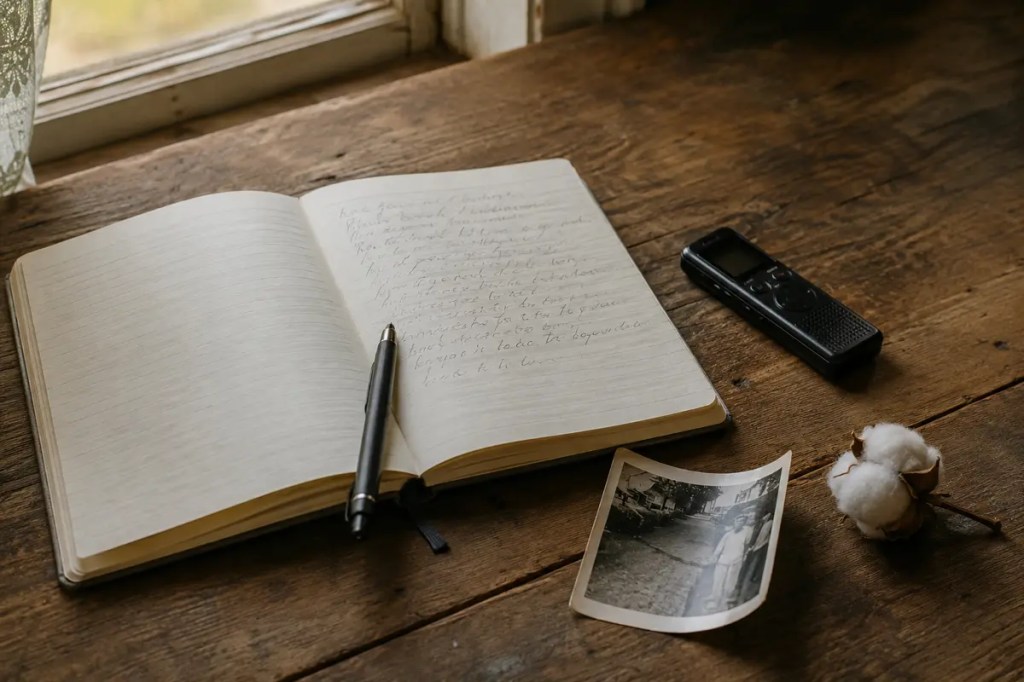
A notebook, recorder, family photograph, and cotton boll arranged to preserve a family story.
A phrase becomes an inheritance when the story around it is preserved.

That’s what makes these phrases more than colorful old speech. When a saying dies, the circumstance that produced it starts to disappear too. “What did you come for, a chunk of fire?” makes very little sense until someone explains the old stove, the borrowed coal, and the hurry involved. Once the story is attached, the phrase becomes a tiny doorway into a world. Without the story, it is just a strange collection of words.

As a father, I think about how easily my children have inherited names and photographs without inheriting voices. They may know where somebody lived and when they died, but not how they sounded when somebody got too big for their britches. They may recognize a face in a picture but never hear the phrase that could bring that person back into the room.

If I give my kids only the saying, I have handed them the shell. The story is the part that breathes. Who said it? What kind of trouble summoned it? Did everyone laugh? Was the lesson understood right then, or did it take twenty years to land? Those details aren’t decoration. They’re instructions.

The hard part is that some of the people I would like to ask are already gone. There are questions I can no longer ask them. That turns this from nostalgia into responsibility. Memory feels permanent right up until the last person carrying it is no longer here to answer the phone.

A father and two children sharing stories on a rural Arkansas porch at dusk.
Fatherhood turns memory into a responsibility to pass something on.

So here is a simple thing worth doing. Ask an older relative what sayings they remember. Don’t stop at making a list. Ask who said each one, when it came out, and what foolishness or hardship brought it out. Record the conversation on your phone or write it down while the voice and the details are still fresh. Then tell one of those stories to your children.

A family inheritance isn’t always land, money, a recipe, or a quilt. Sometimes it is one crooked sentence that kept people patient, cautious, humble, or laughing when life got heavy. It can vanish without anyone rejecting it. All it takes is for everybody to assume somebody else will remember.

Don’t Let Your Child’s Dream Become Somebody Else’s Business Model

Eighty dollars once bought a season.

Eight thousand dollars now buys a year.

That was the contrast in a Morning Brew story about youth sports: one Florida parent remembered paying $80 for recreational sports during her childhood. She now spends about $8,000 each year on club baseball for her 12-year-old son.

Those aren’t identical experiences, of course. Recreational ball and club ball (or travel ball, round these parts) promise different things. That difference is where the business model lives.

Parents watch children play baseball beneath the lights of a modest small-town Arkansas ballfield.

I understand the parent’s side of it.

I am a father. I have watched my children play sports, and I know the desire to give them every honest chance. If one of them possesses real ability and the willingness to work, I don’t want money, geography, or my own hesitation to become the reason a door closes.

I also work in sales and marketing, so I know what happens when fear can be connected to a purchase.

Youth sports has found one of the most powerful fears a parent carries: What if my child could have become something, and I was the one who said no?

Once that fear takes hold, we are no longer buying a tournament, a private lesson, or another uniform. We’re buying protection from future blame. The next level always seems to sit behind another registration fee, another hotel weekend, another instructor, or another facility.

The Aspen Institute found that family spending on a child’s primary sport rose 46 percent from 2019 to 2024. Its researchers estimate that parents now spend more than $40 billion each year on youth sports. That does not include everything schools, municipalities, facilities, and sponsors spend around them.

There is too much money involved for parental anxiety to remain an accidental byproduct.

A parent watches a child train inside an expensive elite youth-sports facility filled with commercial signals.

This isn’t an argument against travel teams, serious coaching, or private instruction. Some children want the harder competition. Some coaches change lives. Good training can sharpen talent, build discipline, and introduce a child to opportunities that a small town can’t provide on its own.

The question is not whether the expensive option is always bad.

The question is who still owns the dream.

Is it the child who wants to play? Is it the parent who has invested enough money to need the sacrifice to mean something? Or is it the company promising that one more purchase will keep the future open?

The answer can change quietly.

A child begins with a glove, a ball, and the pleasure of getting better. Then adults add rankings, exposure, specialized training, highlight videos, travel calendars, and the language of scholarships. Eventually, a ten-year-old can feel responsible for producing a return on an investment he never asked anyone to make.

That’s too much weight for a game to carry.

Parents need to be honest about more than the bank account. We should notice whether our child still talks about playing or only about performing. We should ask whether the extra work belongs to his ambition or our anxiety. We should be willing to hear that a dream has changed without treating every dollar already spent as a contract he or she must keep honoring.

A father and child play catch alone on a simple local baseball field at sunset.

Supporting a dream sometimes costs real money. It also requires restraint. Every possible future cannot be purchased, and trying to buy them all can take something from the life the child is living now—rest, friendships, family time, freedom to try another sport, or the right to discover that this was something he loved but not something he wanted to become.

Aspiration is not the enemy. Neither is business. But when an industry profits from convincing parents that ordinary participation is failure, somebody has to protect the child from becoming the product.

A father’s job is not to purchase every possible future; it’s to keep the present game from being taken away from the child.

Sources: Morning Brew: “Youth Sports Brew”; Aspen Institute Project Play: Family spending rises 46%; Aspen Institute Project Play: Private equity and youth sports

Grief as a Crumple Zone: Navigating Loss with Grace

There’s more empty space inside a modern football helmet than you might expect.

That space isn’t wasted. It’s part of what keeps the person inside alive.

The shell, padding and collapsible liners are designed to move and compress. To give the force of a collision somewhere to go before it reaches the head inside. Morning Brew summarized the science in six words: “Distance makes the head blow softer.”

The layered interior of an unbranded football helmet resting on a worn locker-room bench.

That may the best explanation of grief I have ever heard.

Most of us were taught that strong things don’t bend. Strong men keep working. Strong parents hold the family together. Strong Christians trust God and do not ask too many uncomfortable questions. After the funeral, the breakup or the diagnosis, we straighten our backs and try to make our pain as unobtrusive as possible.

People tell us how well we are holding up.

Sometimes what they mean is that we have made our suffering convenient for everyone else.

When my mother died at 60, I learned there is a difference between knowing something and surviving contact with it. I had always known people die. I also know Arkansas is hot in August. Knowledge is one thing. Stepping outside is another.

Death stopped being an idea and became a collision.

I wanted to be strong. I thought strength meant showing as little damage as possible. But rigid is not the same as strong. Rigid is often just one hard hit away from being broken.

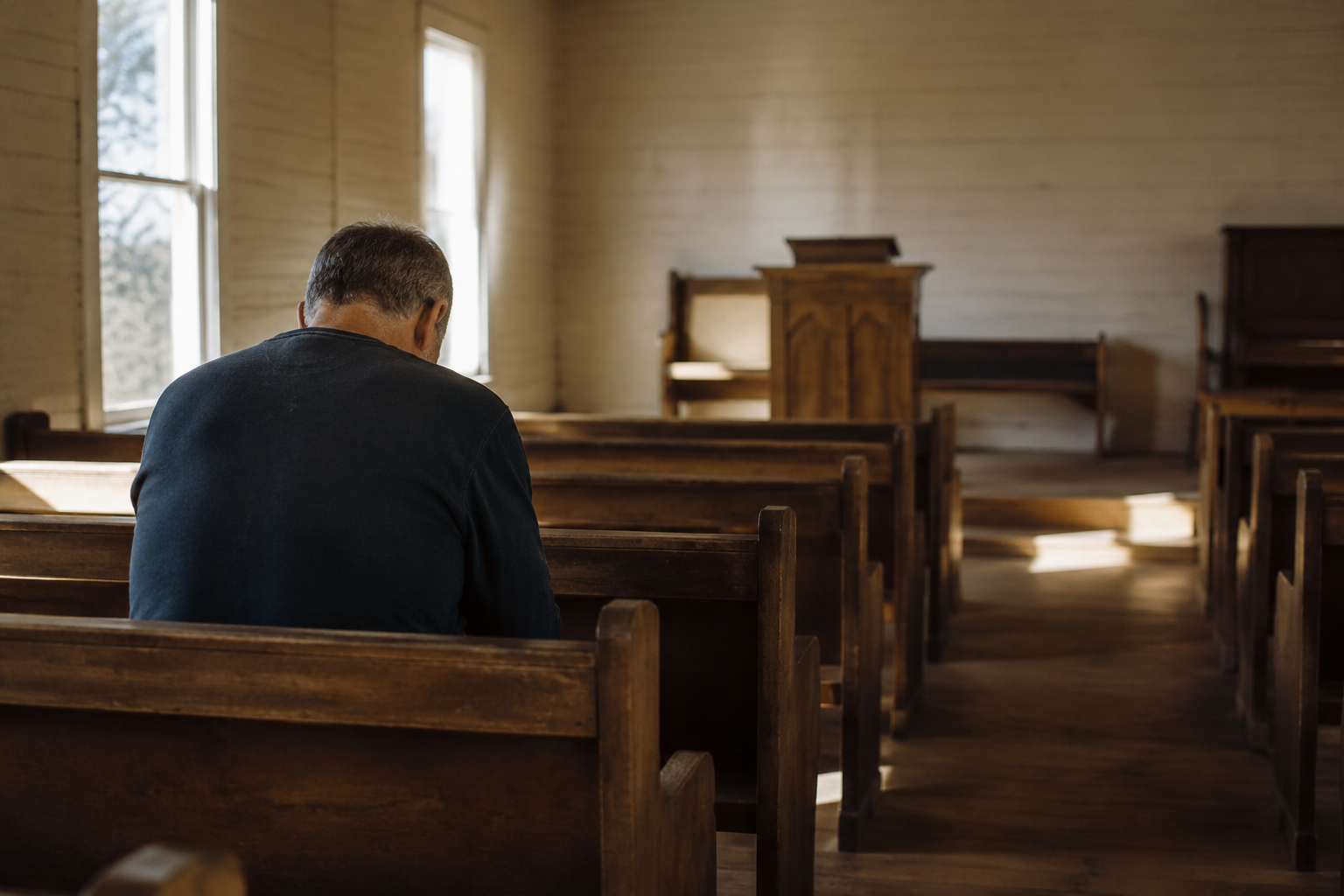
A solitary man seated quietly in a modest rural Arkansas church.

The Virginia Tech Helmet Lab is blunt about this: no helmet is concussion-proof. Better equipment can reduce risk, but it cannot make a violent game harmless. Rules matter. Technique matters. What happens before the impact matters, too.

Grief works the same way. There is no prayer, friendship, ritual or number of calendar pages that makes loss harmless. Faith does not make the funeral less final. A good friend cannot fill an empty chair. Writing can’t revise a page that has already been torn from the story.

But those things can create space.

A friend who sits beside you without trying to fix you. A church pew where you no longer have to pretend you understand. A story told again because saying the name keeps the person from disappearing completely. A notebook, a long drive, a meal somebody leaves on the porch, or a quiet morning when you finally allow yourself to cry.

These are not cures. They are crumple zones.

They give some of the force somewhere else to travel.

A worn journal, Bible, coffee and faded family photograph on an old kitchen table at first light.

We tend to treat yielding as failure. We apologize for the tears. We feel guilty for needing rest. We rush to become the version of ourselves who is “doing better,” mostly because grief makes other people nervous and, if we are honest, it makes us nervous too.

But maybe being strong was never supposed to mean walking away unmarked.

Children grow up. Relationships end. Parents die. Houses empty. Photographs that once looked ordinary begin knocking the breath out of us. Some collisions cannot be prevented, and no honest version of faith or self-help should promise otherwise.

The purpose of a crumple zone is not to pretend the wreck did not happen. The bent metal is proof that it did.

It is also proof that something was allowed to give so the person inside could survive.

Maybe grief needs the same mercy.

Clarity and the Responsibilities Which Come With It

As I sat in the pew every Sunday morning in church, I heard people pray for ‘clarity.’ As a kid, I didn’t understand what that meant. To me, life was simple—no responsibilities, no stakes. But as I grew older, I realized that clarity is one of life’s most sought-after yet elusive aspects. It’s what we crave when we’re faced with hard decisions and uncertain futures 

I’ve had many moments in my adult life where I did just that. All I wanted was a clear path to form before me. I’ve been faced with hard decisions and made tough choices without having enough information present. What I wouldn’t have given for an “eliminate the worst option” or “freeze time” card that could have helped me along the way. Or better yet, why can’t someone just make the RIGHT decision for me?

There is no proverbial light bulb that goes off. You don’t just scratch your head until you have your “aha” moment. Clarity comes when the tangled web of your experiences and your chaotic glimpse of the future magically line up. It’s when you know something must be done in a specific way or in a certain amount of time. In the sense I am writing about, clarity is seeing the best version of a particular part of your life and an actual path toward getting there.  It is more than just a moment of insight—it’s that instant when you know, without a doubt, what you need to do, whether it’s finally taking that job offer or walking away from a toxic relationship. 

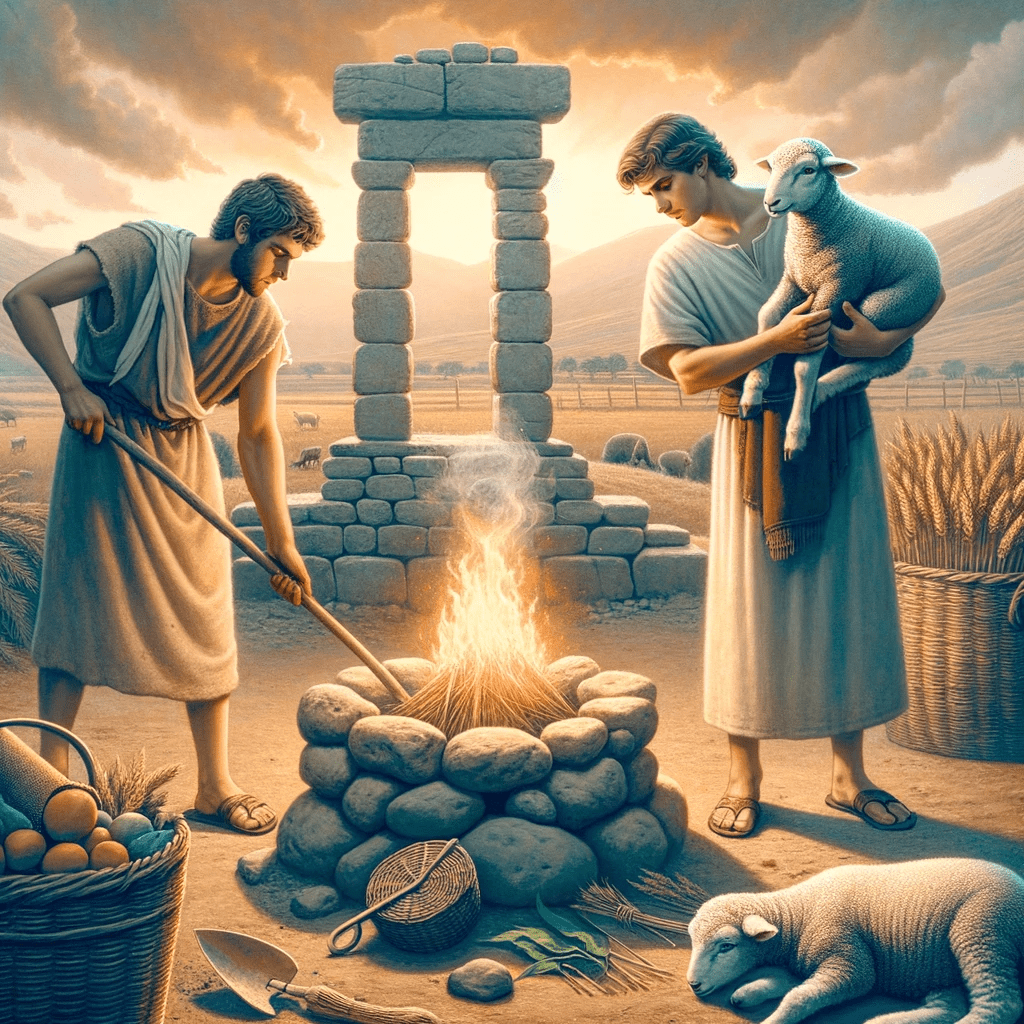
This struggle and the challenge of its brother, hindsight, are not new; they’re as old as time, as seen in the story of Cain and Abel. We all know the story, and I believe that, more than anything, it is a vital allegory about personal responsibility. When Cain sees his brother’s treatment for his hard work and sacrifice, he realizes that he would be getting the same treatment if he had willfully performed the duties asked of him. We’ve all been there to a certain extent.

Imagine finding yourself at the bad end of a situation and then realizing YOU are the one to blame. Everything on the test was covered in class, but YOU didn’t study it. Your transmission goes out in your truck, but YOU blew your money instead of saving it. Your boyfriend breaks up with you because YOU didn’t take the time to learn how he needed to be loved.

Hindsight is 20/20, but clarity happens when you learn these things before it’s too late. Unfortunately, it’s not always as easy as studying for a test or saving money. The problems of life come with layers and complexity.

My grandma always said to be careful when praying for patience or courage because the Lord won’t just give it to you. You’ll have to earn it. He’ll give you opportunities to practice patience and put you in situations that allow you to be courageous. Those aren’t always the most popular places or events to be involved in. I’ve learned the same thing about clarity.

There is a sense of comfort and security in the ambiguity of the future. If you can’t tell what you COULD become, COULD obtain, or the relationships you COULD cultivate, then missing out on them doesn’t hurt. You never saw them and can’t lose what you never had. You can blame outside circumstances, timing, or many other things that are not in your control. You can easily avoid blaming yourself.

Clarity puts the responsibility squarely on your shoulders. It forces your decisions and actions to align with a target. Missing that target has tangible consequences. It requires you to be the best version of yourself so you can be ready to accept the blessings when they start pouring in. It means making multiple sacrifices in the present for what you will obtain in the future. This can be a tireless and trying task. It’s not the carrot at the end of a stick. It’s what awaits you after navigating through the labyrinth.  

Clarity is a powerful gift, but it’s also a call to action. It demands that we face the truth of our choices and take responsibility for our future. Whether we embrace it as a blessing or shy away from it in fear, clarity offers us a chance to shape our destiny. Either way, it’s one hell of a thing to experience. The question is: will we rise to the challenge?

Happy Birthday, Mom

I must have been 11 or 12 years old when my buddy and I got up in front of our church family and sang “A Song for Mama” by Boyz II Men. He was and still is a natural musician with a great voice and a knack for learning any instrument. I, on the other hand, was not and still can’t. But I played the drums and saxophone in church and, at least this one time, even sang a song. I did it because it made my momma happy.

I thought about this song today and gave it a quick play on Spotify, and I tried to take myself back to that moment when we sang it at church. I saw my mom sitting at the piano and his mom sitting at the organ; their faces lit up, and they were proud of the young men their sons were turning into. We could have never known that day that some 30 years later, they would both be gone. If I had known, I would have sung her more songs. As many as she wanted.

My mom would be 62 years old tomorrow and spending most of her time telling everyone about how her oldest grandchild would be graduating high school soon. Or how her youngest is full of sass and spirit. She would be at every football, basketball, or baseball game she could attend. Every cheerleading competition or band recital. She’d find ways to show them how much they mean to her in their own way. And if I’m being candid here, it pisses me off that she got cheated out of so much. Or maybe I’m selfish and upset that she got ripped away from us too soon.

Time is supposed to heal all wounds, and it may eventually. Some days it happens more than others, but I think about her daily. 95% of the time, those thoughts make me smile or even put me at ease, but that other 5% is brutal, man. When I see someone’s silhouette and mistake it for hers. When I hear a laugh that sounds like her laugh. When someone mentions seeing her in my kids. Those days the grief holds on and doesn’t let go.

“I’ll never go a day without my mama.” That’s a line from the song I took issue with after listening to it. I’ve gone many days without her now. She won’t be at the table during holidays or taking pictures in the background. She won’t be bringing me a drink out of the blue or calling to see how my day at work went. I can’t listen to her play the piano or seek her advice when I’m in a bind.

But, dadgum it, she lives on. She lives on in me and my children and the memories that live rent-free in my head. The photos come to life, and the home videos tell new stories. She lives on in this blog and the stories I tell my kids, and hopefully, they’ll recant to theirs. She’ll forever keep that special place in my heart and soul, and her sweet voice will always ring in my head.

I write these things out and throw them in the wind for 2 reasons. For one, it helps me clear my mind when things get all jammed up in there and must be purged. And secondly, I want this to be accessible to someone who might be going through a similar situation and not know how to deal with it. Maybe my words can comfort them or get them through the day. Almost everyone has had to deal with loss at some point. But that doesn’t mean it is ever easy.

Happy birthday in Heaven, Mom. I’m doing my best down here, I promise. Love you always!

This Christmas

This Christmas, some people will sit around the TV and watch sports while talking about how nice it is to have a break from work. But others will be going into the new year hoping to get a call back from one of places they left their resume. And some will be patrolling streets, fighting fires, working the counter at a gas station, pulling a double shift at the hospital, or making sure we keep the electricity turned on.

This Christmas, some people will be surrounded by loving family in a home filled with joy, laughter, and excitement. But some people will be sitting all alone with no one to enjoy it with. Or on the open highway because they can’t stand the feeling of an empty house. Some wives will be sitting next to abusive husbands, trying their best to hide their pain from everyone else. Some men will be watching their cheating wives pass presents around for the kids, wondering how long they can hold on to a marriage that’s failing.

This Christmas, some people will pick up their grandkids or play football with their cousins. But some people won’t be able to pick themselves up out of their wheelchairs. And others will have just received horrible news about an inoperable tumor. Some people will be spending their Christmas day hooked up to ventilators or IV drips, and others will stare at the walls in a nursing home, praying they had family to come visit them.

This Christmas, some parents will take pictures with their infant as they soak in the experience of a child’s first Christmas. But others will be mourning the first holiday season without their child. Some will know that this might be the last Christmas with an aging parent or loved one, while others will have to muddle through the season with a fresh loss hanging heavy over their heart. Chairs that have been filled for years will be empty and many familiar faces will be permanently absent.

This Christmas, most of us will have access to a warm house, running water, electricity, and edible food. But many others won’t have any of these things. Some parents will endure fatigue, hunger, and their own well-being just to put a smile on their childrens’ faces, even if only for a moment. And some won’t have the means to even be able to that.

This Christmas, some will slow down and take stock of all the blessings present in their lives. And others won’t realize what they have until they don’t have it anymore. And since we will never truly know the  full situation of our neighbors or strangers we may encounter, a little bit of empathy can go a long way.