
You Can Chase the Dream After Everyone Else Is Fed

“Sell your flock.”

It is the kind of advice that sounds brave because it fits neatly inside a sentence. Leave the familiar town. Give up the steady life. Trade security for possibility. If you want the dream badly enough, prove it by walking away from everything that keeps you comfortable.

That makes sense when the flock is only a metaphor for fear.

It gets more complicated when the flock has names.
A working father stands beside a flock at a rural gate while an open road stretches toward the sunrise.

I have three children. There are groceries to buy, insurance to maintain, lights to keep on, and promises that can’t be suspended while I go looking for myself. Other people have built part of their lives around my dependability. Their needs are not evidence that I have surrendered my potential. They’re part of the life I am responsible for living well.

We have developed a strange habit of treating departure as the purest form of courage. The man who quits his job, sells everything, and bets on himself gets the dramatic story. The man who goes to work, comes home tired, helps with what needs helping, and returns to his dream after the house is quiet rarely gets a montage.

But the absence of spectacle does not mean the absence of bravery.
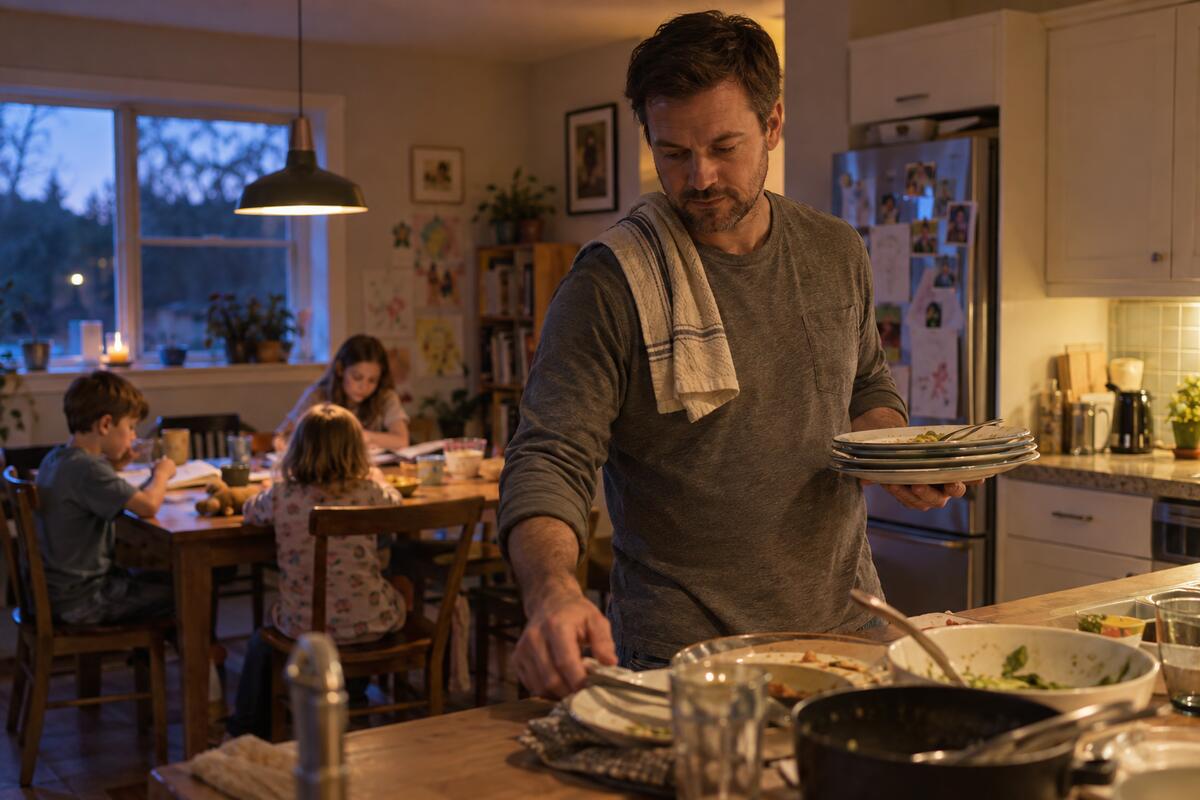
A father clears the family dinner table while his three children finish their evening nearby.

I wrote a book while working in the car business and raising three children. Most of the sessions didn’t feel heroic. They felt inconvenient. I wrote when the day had already spent most of what I had. I learned things I didn’t know how to do. I questioned whether the work was good enough and whether anyone would care. Then I went back to it.

The book was not produced by abandoning my responsibilities. It was built around them.

That doesn’t mean staying is always noble. A paycheck can become an excuse. Responsibility can be used as a respectable name for fear. Plenty of people say they are waiting for the right time when what they mean is that they hope desire will eventually stop asking anything of them.

Patience and surrender may look alike from across the room, but they leave different evidence.

Surrender says “someday” and makes no appointment. Patience puts an hour on the calendar. Surrender collects reasons. Patience collects pages. Surrender waits for life to become less demanding. Patience accepts that a meaningful life may always be demanding and learns to build anyway.

There may come a day when the responsible decision is to leave the secure job, change the plan, or give the dream more room. Courage may eventually require a larger risk. But quitting isn’t automatically courage, just as staying is not automatically cowardice. The question is not whether the choice looks bold from the outside. The question is whether it honors both the calling and the people entrusted to you.

I still intend to write fiction. That work matters to me. I don’t believe the dream has expired because I have not yet reorganized my entire life around it. The dream is alive every time I protect a small piece of the week from everything else. It is alive when I choose the page over another hour of distraction. It is alive when I keep a promise to the work without breaking promises to the people I love.

A father writes at a small desk after the household is asleep, surrounded by quiet signs of family life.

There is nothing romantic about neglect. A dream financed by hungry children, broken commitments, or people left carrying your share of the load is not freedom. It’s simply selfishness with better lighting.

So feed the flock. Pay what must be paid. Keep the promises that made your life larger than your own. Put the house to bed.

Then return to the manuscript.

Returning Is Not the Same as Going Back

Seconds before Céline Dion sang the first note of her first full concert in six years, the stage probably looked much like it always had. Lights. Musicians. A waiting crowd. A microphone in the place where a microphone belongs.

But six years were standing beside her.

Illness had interrupted the life she knew. The return required years of physical and vocal work, and the road was longer and rougher than she expected. When she finally began, she became so emotional that the audience had to help carry the opening song.

That’s the part the word “comeback” usually leaves out.

A singer stands beneath a spotlight in the silent moment before beginning a return concert.

Comeback is a clean word. It makes absence sound like an intermission. It suggests someone stepped away, handled a problem, and returned to the same stage as the same person, ready to pick up exactly where she left off.

Real life is seldom that tidy.

Illness changes the person inside the body. Grief changes the person who walks back into the house. Divorce changes the person who tries to trust again. Parenthood changes the person who returns to ambitions he once imagined pursuing without interruption.

Even good change has a cost. We don’t pass through six years—or six months, or one terrible week—and remain untouched.

For a long time, I thought rebuilding meant restoring. I imagined there was an earlier version of my life sitting somewhere intact, waiting for me to find the right road back to it. If I could recover the right habits, confidence, relationships, or sense of direction, perhaps everything would feel familiar again.

But rebuilding is not restoration when the original materials have changed.

A middle-aged Arkansas writer returns to an old manuscript at a desk shaped by years of family life and change.

When I returned to writing seriously, I was not retrieving some untouched version of myself who had merely been waiting for an available afternoon. I brought the years with me: work, fatherhood, disappointment, grief, mistakes, and questions I could not have written honestly before I had lived them.

Some of those experiences reduced me. They took confidence, energy, and certainty. I would not insult anyone’s pain by pretending every loss secretly arrives as a gift. Some things hurt because they are hard, and some absences remain absences.

Still, reduced capacity does not automatically mean a lesser life.

Sometimes the person who returns is better than the one who left—not because the suffering was good, but because he learned to stop wasting what is. He may be slower but more patient. Less certain but more honest. Less impressed by appearances and more grateful for ordinary days. He may finally know which promises deserve his strength and which expectations never did.

That is a better version, even if the measurements we usually celebrate cannot detect it.

The hard part is allowing the new person to build a life he can actually inhabit. We can exhaust ourselves trying to perform at an old pace, recreate an old relationship, recover an old identity, or prove the interruption did not change us. Sometimes healing begins when we quit treating change as evidence of failure.

A man enters a familiar room again, carrying the evidence of the life that changed him.

Returning may mean singing differently. Working differently. Parenting differently. Praying differently. It may require boundaries the former version of us never needed, gratitude he never understood, and the humility to accept help when the first note will not come.

A return is still worth celebrating. But not because it erased the years away.

It is worth celebrating because the person who lived through them stood in the light as he was—changed, grateful, uncertain, and willing to begin again.

You can return to the stage, the work, the faith, or the relationship—but you cannot return as the person who left.

Sometimes that is not the tragedy. It is the gift.