The Real Difference: Charisma vs. Character

Some people can control a room beautifully but can’t be trusted alone with making a decision.

You’ve probably met one. They remember names, hold eye contact, tell a story at exactly the right moment, and make the people around them feel smarter and more hopeful than they did before they arrived. By the time the coffee cools, the room belongs to them.

That is a real ability. It’s also incomplete evidence.

Charisma answers one question: How do people feel while you are speaking? Character answers a harder one: What becomes true because they trusted you?

I’ve spent most of my adult life in sales and leadership, two places where charm has a scoreboard. Good communication matters. A customer should feel comfortable asking a question. An employee deserves a leader who can bring clarity and hope into a difficult day. Eye contact, timing, confidence, stories, and good questions can all be learned. Learning them is not dishonest. Warmth can be a genuine form of service.

But the appearance of care can be learned faster than responsibility.

A warmly lit automobile showroom where a man speaks to an attentive group.

A salesperson can make a customer feel understood and still disappear when the paperwork is signed. A manager can fire up a room on Monday and avoid the truth when Friday brings bad news. A person can speak beautifully about faith and still use influence carelessly when there is no microphone nearby.

The same danger exists in relationships. It’s possible to know how to make another person feel special without knowing how to be honest, consistent, or responsible for the effect you have on them.

But charisma is not always a disguise.

I once dated a woman who had an unusual gift. Whoever she was speaking to—regardless of title, money, or station in life—felt like the most important person in the world. She listened in a way that made it seem as if the room had emptied around you.

That could have been charm alone. What convinced me otherwise came later.

Long after our relationship ended, she would reach out from time to time to ask how I was and remind me that she was still in my corner, rooting for me. There was nothing left to win. No audience. No advantage. Her care had outlived its usefulness.
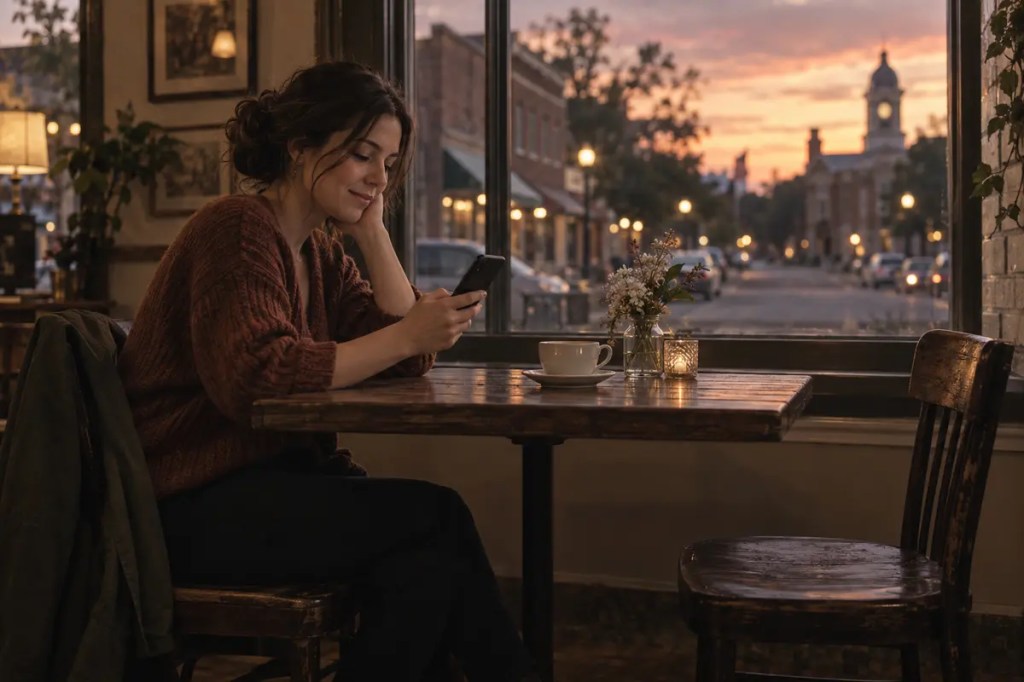
A woman sends a quiet check-in message from a café at dusk.

That doesn’t mean every relationship between two good people should continue. Goodness doesn’t erase incompatibility, history, or the need for boundaries. It simply means her warmth was not manufactured for a result. The attention she gave people was connected to something sturdier than technique.

Manufactured sincerity asks a question to find leverage. Genuine presence asks because the answer matters.

We should not become suspicious of every charismatic person. Cynicism can be as lazy as seduction. Some people are naturally gifted with presence; others work to communicate better. The skill itself is not the moral issue. Character decides what the skill serves.

The test usually comes after the impressive part is over. Was the promise kept? Was the bad news delivered honestly? Was the phone call returned when there was nothing else to sell? Did the leader protect the absent person, admit the expensive mistake, and restrain the power he could have used for himself?

Character leaves evidence outside the spotlight.

A manager has a quiet, honest conversation in an almost-empty dealership at dusk.

I know how easy it is to confuse a good response with proof of a good heart. A successful meeting, a relieved customer, an energized team, or a kind comment from a reader can all feel like confirmation. But being convincing and being worthy of belief are not the same accomplishment.

If I want to know what kind of person I am becoming, the better question is not whether people enjoyed hearing me speak. It’s whether my family, coworkers, customers, and friends are safer because I told them the truth and kept my word.

Charisma may open the door, but character decides what you do after you are invited inside.


Source note: Inspired by Deepstash Daily’s summary of Robert Greene’s The Art of Seduction.

The Power of Asking the Right Questions

Two people can stand in the same kitchen, speak plain English, and understand almost none of each other.

One says, “Fine.”

The other hears, “The problem is settled.”

The first person may have meant, “I’m tired,” “I don’t feel safe explaining this,” or “You have already decided.” Both people know what fine means. Neither one knows what just happened.

The words were translated correctly.

The person was missed.

Two people stand apart in the same kitchen after their words fail to reach each other.

An email from ChatGPT recently promoted the ability to translate text, voices, and photographs, then use follow-up questions so the answer fits the moment. That is remarkable technology. But some of the most consequential translation failures happen between people who share a language, a workplace, a home, or even a last name.

The dictionary is nearly useless with certain sentences.

A child says, “I don’t care.” That may be indifference. It may also be fear posing as indifference because trying and failing would hurt more than pretending the thing never mattered.

As a father, I have not always heard the difference.

Sometimes I’ve answered the sentence instead of the child. I heard attitude and responded with correction. I heard laziness and gave a speech about effort. Maybe the correction was needed. Maybe the speech was true. But truth delivered to the wrong meaning still misses its target.

The better response is often a second question:

“When you say you don’t care, what do you mean?”

A father sits beside his teenage son, leaving enough room for the second answer to arrive.

Leadership has its own false translations.

An employee says, “I understand.” A manager may hear agreement, commitment, and a clear next step. The employee may only mean, “I understand that you are finished listening.”

That’s why it isn’t enough to ask whether someone understands. Ask what they believe the next step is. Ask what part still feels unclear. Inspecting what you expect is not only about numbers in a CRM. Sometimes it means checking whether the same conversation happened on both sides of the desk.

Salespeople learn this lesson every day—or they should.

“I need to think about it” can mean price. It can mean trust. It can mean embarrassment about money, fear of making a mistake, or a polite no. A bad salesperson translates the phrase into an objection to defeat. A better one asks, “What part would you like to think through?”

Not to trap the customer. To stop guessing.

A dealership manager sets his work aside and listens carefully to what an employee is actually trying to say.

Relationships are full of words that carry more than their definition. Later can be a promise or an escape. Respect can mean obedience to one person and consideration to another. Effort can mean intention, visible action, consistency, or sacrifice. I’m good can mean exactly that—or it can mean, “I don’t know how to ask you to stay.”

The danger here is mind-reading.

We should not treat every simple answer as a code to crack. Sometimes “fine” means fine. “No” still means no. Curiosity does not give us permission to replace another person’s words with the story we prefer.

The distinction is simple: mind-reading assigns a hidden meaning. Curiosity asks whether there is more meaning to hear.

I’ve been guilty of translating people into versions that were easier to manage. The child became an attitude problem. The employee became resistant. The customer became an objection. The person I loved became unreasonable.

Those translations saved time.

They also cost connection.

The second question is rarely efficient. It may extend the meeting, slow the sale, complicate the discipline, or reopen the conversation you hoped “fine” had ended. But people are not sentences to process. Listening is not finished when every word has been recognized.

A dictionary can tell you what the words mean. Real listening begins when you ask what the person meant.

Source: OpenAI Help Center, “ChatGPT Capabilities Overview”.

The Two Paths of Decision-Making

There is an infinite number of rabbit holes a person can find while using the internet. Some are dark and creepy. Others are light-hearted and funny. Many of them will find you wishing you had the time spent back, and a few of them may help you be more productive. One of my recent rabbit hole dives led me to The Knowledge Project, a podcast hosted by Shane Parrish. From that podcast, I found his website, The Farnam Street Blog, which provides articles and exposes that center on how and why we handle the process of decision making.

There are some fascinating articles on the blog and some fantastic interviews on the podcast. I would suggest checking either or both of them out. But one theme that pops up now and then is the idea of making decisions based on the probable outcome. More specifically, do you make decisions based on the best possible ending or eliminating the worst-case scenario?

fs.blog

Most people would probably pick like me and say the former rather than the latter before they put a lot of thought into it. On the surface, who wouldn’t want the “best possible outcome?” But when you look back on your life and analyze some of your decisions, is that what you did? And if not, do you regret it? Will you change the way you make your decisions going forward? Let’s look at two different scenarios and then think about how you handled or will handle them in your life.

Love

If you could see fifty years into the future when choosing who you will spend your life with, how does your ideal scenario play out? For me, it would be a lifelong love affair with someone I connect with on the deepest level. It would be hills and valleys but having them right there by my side the whole time. They would be by my side for the suffering and the joy, and we would share our experiences every step of the way. I’m sure everyone’s answer is a little different, but that’s what it would look like for me. On the flip side, though, what kind of roadblocks would you have to stumble over if you made your choice like that? How much would you overlook, and how far would you let it go?

But what if I decided to eliminate the worst-case scenario? I would probably settle down with someone financially secure who had good genes to pass down to our children. And, we would take those pictures in the fall with the trees in the background (to make sure the grandparents were pleased). I would probably even sacrifice passion and attraction for security and acceptance.

Now I’m not saying that you can’t have both, by the way. And, I’m not saying you’re wrong if you choose to go with the more safe and secure path. I think it’s interesting how we shape our lives by eliminating some of the variables that could leave us vulnerable in the end–nothing more and nothing less.

Career

The best-case scenario in your career would be sticking to the adage, “Find something you love to do, and you’ll never work a day in your life.” If you can take a passion, skill, or gift and find a way to monetize it over the long term, you will probably end up very fulfilled and satisfied when it is time to retire. But there are apparent risks while traveling down this path. How long do you have to wait before your passion becomes lucrative? How many times do you have to fail until you get it right? How does that affect your health and your family?

In this situation, the worst-case scenario is finding yourself broke and not providing for your family. How do you eliminate that? Most people decide to find a place that will pay them regularly, and they trade out that paycheck for 40 hours or more a week. There’s not much risk involved as most jobs won’t require a financial investment. If you can handle the workload and hours, you will have some change in your pocket at the end of the week after making enough money to provide for your family.

Again, there is nothing wrong with either one of these options. One is more romantic and risky, and the other is safe and secure. It just goes to show you how our decision-making process can shape the way our lives play out. The examples I mentioned above would be considered “major choices” in the long run. Still, we make these same kinds of differentiation in almost every micro decision we make daily.

How did it affect your most recent car purchase? What about your interaction with the person in line in front of you at the bank? Even when picking out what music to listen to on the road home or where to pick up takeout, we are constantly weighing the option of “best possible outcome” or “eliminating the worst-case scenario.”

I believe the key to living a satisfying life is finding the harmonious balance between these two ways of making decisions. After all, we are only the sum of our choices. Choose wisely, my friends! Too much risk may find us in the shower biting our knees in agony, but not enough of it may leave us cold and unfilled.