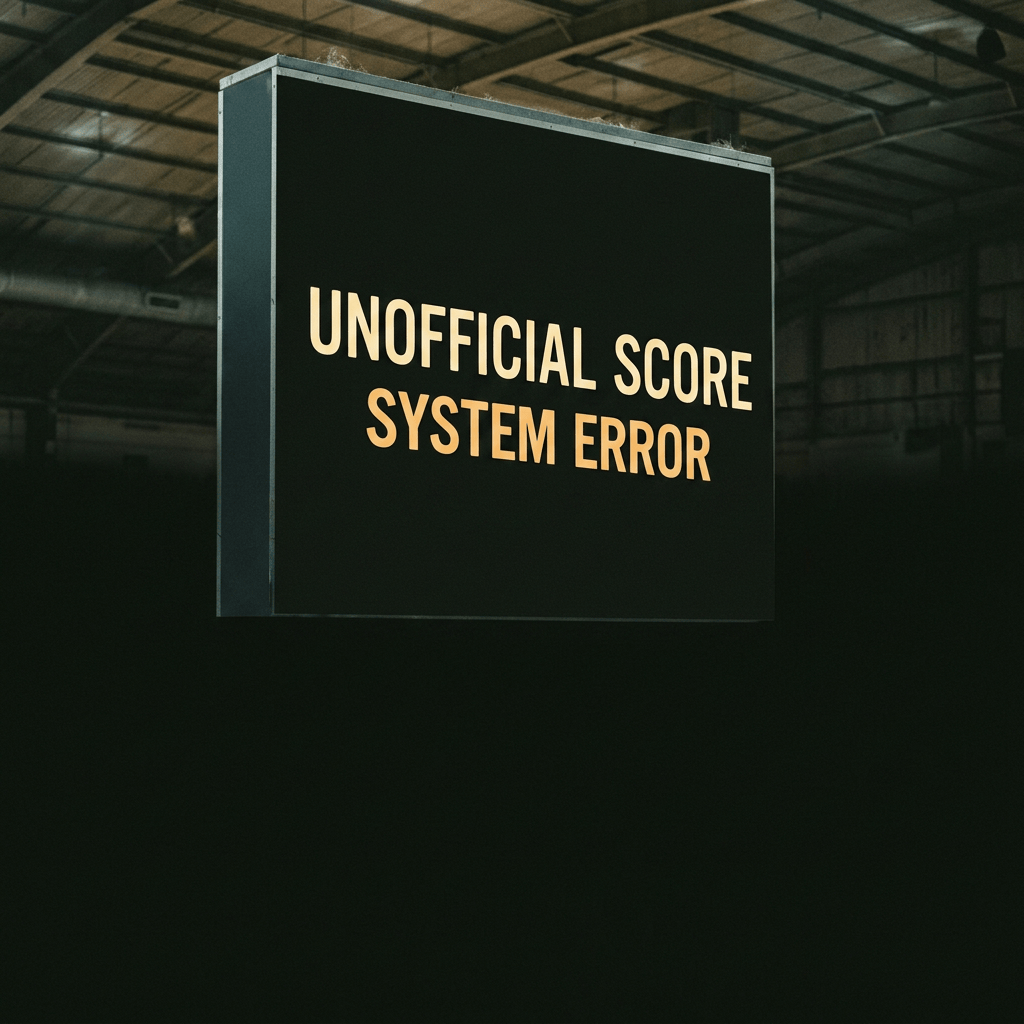
The Scoreboard Is Lying to You

The car business loves a scoreboard.

Units sold. Gross profit. Closing percentage. Calls made. Appointments set. Products sold. Month-to-date pace. Yesterday’s number sits beside today’s goal, and every morning the board tells us whether we are ahead, behind or in need of a very uncomfortable meeting.

I understand the appeal. A scoreboard is clean. If the goal is thirty and the total is twenty-eight, nobody needs a committee to determine whether you reached it.

Numbers are useful. I have spent most of my adult life looking at them, managing by them and occasionally trying to explain why a particular one should not be interpreted too harshly until at least next Tuesday.

The problem begins when a useful measurement becomes a complete verdict.

A salesperson has a bad month and starts believing he is bad at his job. A manager misses a goal and carries the failure home like it belongs at the dinner table. A strong month produces the opposite illusion: the number is high, so everything must be working.

Then the calendar turns over.

The scoreboard resets to zero and begins demanding proof again.

Life has scoreboards too, although they are considerably less honest about who installed them.

Income. Job title. House. Relationship status. Weight. Followers. Children’s accomplishments. The age by which we believe we should have achieved something. We collect measurements from family, culture, social media and people we barely like, then act surprised when winning their game does not feel like winning ours.

I have done this repeatedly.

There have been months when work went well and I felt ten feet tall. There have been months when I questioned decisions stretching all the way back to the first job application I ever filled out. I have looked at money and felt successful, then looked at less money and wondered whether the earlier version of me had been a fraud. I have treated relationship status like a grade on my ability to love and career progress like an official ruling on my potential.

The score kept changing because I kept asking one number to measure an entire life.

That is too much work for any number.

Money matters. Anyone who says it does not has probably never tried to figure out which bill can wait until Friday. Career matters. Health matters. Relationships matter. Goals matter.

But none of them, by itself, gets to announce the final score.

A person can earn more money while becoming someone his children barely know. He can lose a job and become more present, more creative and more alive. A marriage can end without proving every year inside it was meaningless. A child can struggle without becoming evidence of a parent’s failure. A body can change while the person living inside it grows wiser.

Sometimes the number is telling the truth about the category and lying about the person.

Twenty-eight is still short of thirty. Pretending otherwise does not help anybody. But “we missed the goal” and “we are failures” are not the same sentence.

One gives us information.

The other gives the information authority it never earned.

While writing A Nobody’s Guide to Self-Help, I kept returning to the gap between the life we expected and the one we are actually living. Most of the pain in that gap is real. Some of it comes from loss, mistakes and roads that genuinely closed.

But some comes from standing beneath a scoreboard we did not build, losing a game we never consciously agreed to play.

So I have started asking different questions.

Not only: How much did I earn?

Also: What did earning it cost?

Not only: Did I reach the goal?

Also: Did the pursuit make me more disciplined, honest and useful?

Not only: Does my life look successful from the outside?

Also: Do the people I love experience me as someone who shows up?

Those questions do not eliminate measurable goals. They put them back in their proper place.

A scoreboard should help you understand the game. It should not be allowed to tell you whether your life is worth playing.

Look at the number currently deciding how you feel about yourself.

What is it actually qualified to measure?

And what have you allowed it to say that it never had the authority to decide?

Thursday Night Football and Shipping Containers

Months before the Los Angeles Rams crossed the Pacific, a shipping container was already making the trip.

Inside were game-day drinks, supplements, food, and supplies. The kind of things nobody in the stands would notice unless they are missing.

The NFL’s first regular-season game in Australia will be played under the lights at the Melbourne Cricket Ground. That is the part made for television: the uniforms, the crowd, the opening kick, and the announcer reminding us how far everybody traveled.

The less glamorous part began 218 days earlier.

The Rams had to move roughly 25,000 pounds of equipment in 90 trunks. Every trunk needed a manifest listing what was inside, what it was worth, and where it came from. Australian biosecurity rules meant the cleats had to arrive free of dirt, seeds, and grass. Somewhere, while the players prepared to play football, an equipment manager was scraping yesterday’s practice field from the bottom of somebody else’s shoes.

A shipping container carrying game-day supplies crosses the Pacific months before kickoff.

That may be the most honest picture of leadership I have seen in a while.

We like the visible moment. We celebrate the touchdown, the sale, the finished book, the family picture, and the number at the bottom of the report. We rarely ask who made sure the right cord, form, meal, key, or backup plan was in the room when the moment arrived.

The game isn’t won in the shipping container. The players still have to play. Preparation can’t guarantee an outcome.

But a great many things can be lost there.

An equipment manager removes every trace of dirt and grass before the cleats can clear customs.

At a dealership, the customer sees the delivery photo. He sees the clean vehicle, the keys in his hand, and the smile that gets posted online. He doesn’t see the inventory checks, the trade appraisal, the lender calls, the paperwork corrections, the detail department, the fuel, the insurance verification, or the person who caught the missing signature before it became tomorrow’s problem.

When those pieces work, the final moment looks easy. That’s the strange reward of good preparation: it often removes the evidence that it was necessary.

Leadership is not only performing well when the pressure arrives. It’s reducing the number of emergencies everyone else will have to survive. Pressure may reveal preparation, but it rarely replaces it.

Before the doors open, a dealership manager prepares the paperwork, keys, and vehicle behind the delivery photo.

Fatherhood contains the same invisible work. Children see Christmas morning, not the calendar, sacrifice, and quiet worry behind it. They see the uniform ready for practice, not who remembered to wash it. They see that somebody showed up, not the rearranged day that made showing up possible.

That doesn’t mean children owe us applause. Love becomes something uglier when every sacrifice is presented as an invoice. The point is not to make people feel guilty for enjoying the moment. The point is to respect the work required to make good moments dependable.

Writing is no different. A reader sees the finished essay, not the notes carried around, the weak opening deleted, or the paragraph that had to be rebuilt because it sounded better than it was true. The published piece is kickoff. Most of the real contest happened when nobody was watching.

There’s a temptation in responsible lives to resent that invisibility. We want somebody to notice the early morning, the second check, or the problem prevented so completely that it never became a story. Sometimes they will. Often they won’t.

Do the work anyway.

The crowd will remember who caught the pass. The customer will remember the keys. The child will remember the morning. But somewhere before each visible moment was a person nobody applauded—the one who packed what everybody else would need before they knew they needed it.


Source note: Inspired by Morning Brew’s reporting on the Rams’ Australia game and Sports Illustrated’s inside account of the team’s 15,000-mile operation.

Shoot for the Moon…or Anywhere–Just Shoot

“Shoot for the moon. Even if you miss, you’ll land among the stars.” I think I heard that line a million times when I was growing up. If I’m not mistaken, it was actually the Senior motto of our graduating class (it “beat out,” another less appropriate phrase that everyone REALLY voted for). In practical terms, it means to set a goal, work towards it, and then let the results fall where they may. Assuming you work hard, you can be proud of whatever happens.

Okay. I get that. On the surface, it is a harmless little motivational whim that can make us all feel better about the randomness and injustices of life. But as I’ve gotten older (hopefully a little wiser), I’ve thought about this often. I’ve come to the conclusion that this quote is misguided. The problem is that no one ever talks about the how. What exactly does it mean to “work hard?” It shouldn’t be about the moon; it should be about the “shooting.”

The problem lies with the destination. If everyone is shooting at the same target, many people will definitely hit the mark. But how? Many variables are operating behind the scenes. Genetics, timing, upbringing, nationality, luck. Plenty will land on the moon in part or whole by inadvertently combining some of these factors, regardless of their work ethic or “shooting ability.”

On the flip side, many people who put in the time and effort to get there won’t. These same factors, and more, can be as big of a hindrance to them as it is helpful to someone else. Consider the haughty arrogance of someone who made it to the moon by chance. Now contrast that to the smothering defeat that could be felt by someone who “did everything right” but still fell short.

So if we can get to the moon by chance or, conversely, never get there despite our best efforts, then is the moon really a good thing to shoot for. I’d say yes. It provides a tangible goal to pursue—a prize to keep our eyes on. But I’d argue that the framework we put in place to get there is far more critical than that. As my boss has taught me over the years, “A goal without a plan is just a wish.”

Another cliché I’ve heard tossed about is, “It’s not about the destination, but the journey.” I like this one much better. The idea that the process along the way is more important than the actual destination appeals to me. It takes quite some time to get to the moon. What if your circumstance changes? What if something happens to the moon? What if you find something better to aim at?

The key is to take the time to develop a plan, tediously implement it, and hold yourself accountable for your effort daily. Even if you fall short of the moon, you’ll be better prepared to tackle your next trip than someone who arrived there by luck, chance, nepotism, et. You will continue building on the experience you’ve earned on your travels. In contrast, the latter person won’t be prepared to aim at their next target and will continue to depend on outside factors for their success. Or, they’ll decide to stay on the moon. It’s a big universe out there. Why stop there?

The beginning of a new year is the perfect time to sit down and figure out where you want to aim and set your trajectory. The moon is a popular destination, but another place could better serve our time, effort, and vision. How do we get there? That depends on way too many individual factors for me to be able to answer. But the plan, implementation, execution, and accountability will be the most essential factors in determining the quality of your journey. And if you can get those down, I promise it will be one hell of a trip…whatever you decide to shoot and wherever you happen to land.