Celebrating Unconventional Hobbies: The Hobby-Horse Phenomenon

The phrase “hobby-horse championship” practically arrives with its own smirk.

For an adult who has forgotten how seriously children can take play, the picture is easy: kids running around a gym with stuffed horse heads on sticks. Cute. Strange. Something to watch for thirty seconds before moving on.

But stay a little longer.
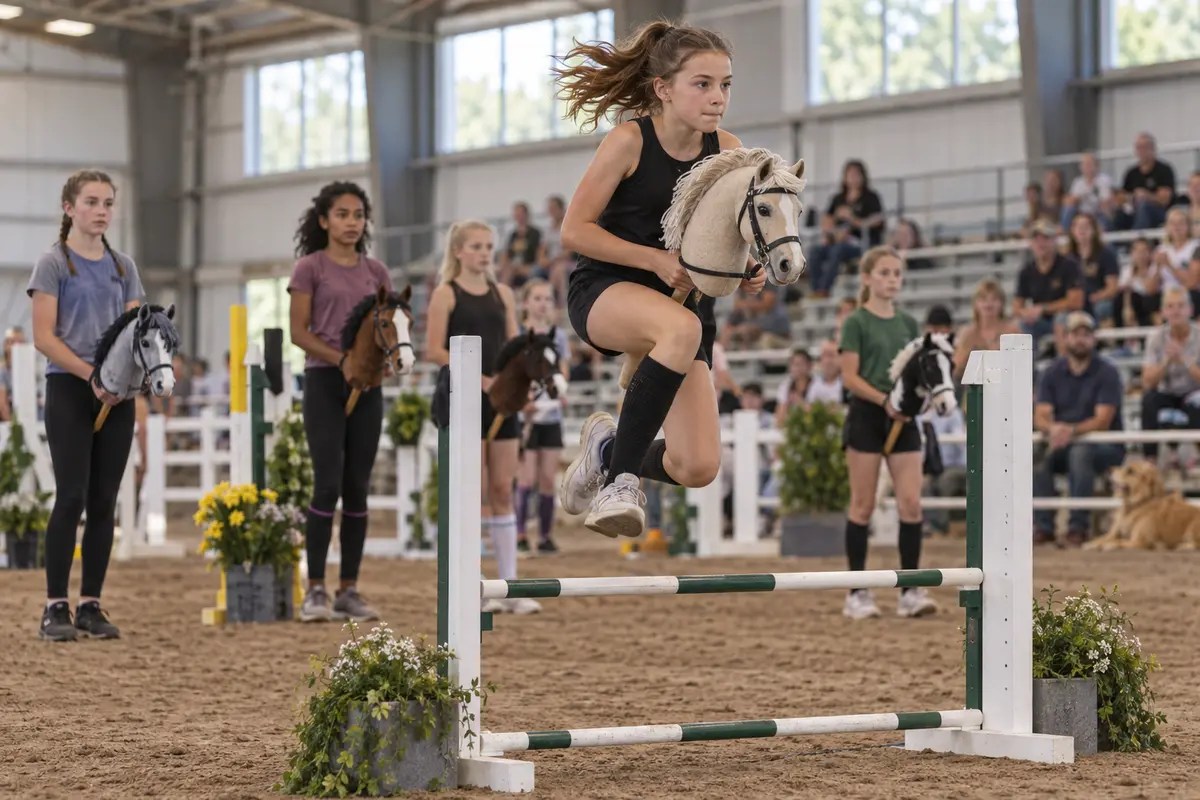
A young hobby-horse athlete clears a jump while fellow competitors and families watch inside an indoor arena.

This summer, 400 registered competitors gathered in Brighton, Michigan, for the U.S. Hobby Horse Championships. They ran jumping courses, performed dressage, and competed in rodeo-style events. Most were young girls. Many had designed and made their own horses and tack.

The championship itself began with four young athletes who met online in 2023. They didn’t wait for a school, league, or grown-up institution to decide their interest was legitimate. They built the competition they wished existed.

Stay long enough, and the smirk starts to lose its footing.

There is athleticism in the jump. Craftsmanship in the horse. Courage in performing something you love while knowing other people may laugh. There is friendship, practice, imagination, and the stubborn human need to find people who understand why a thing matters.
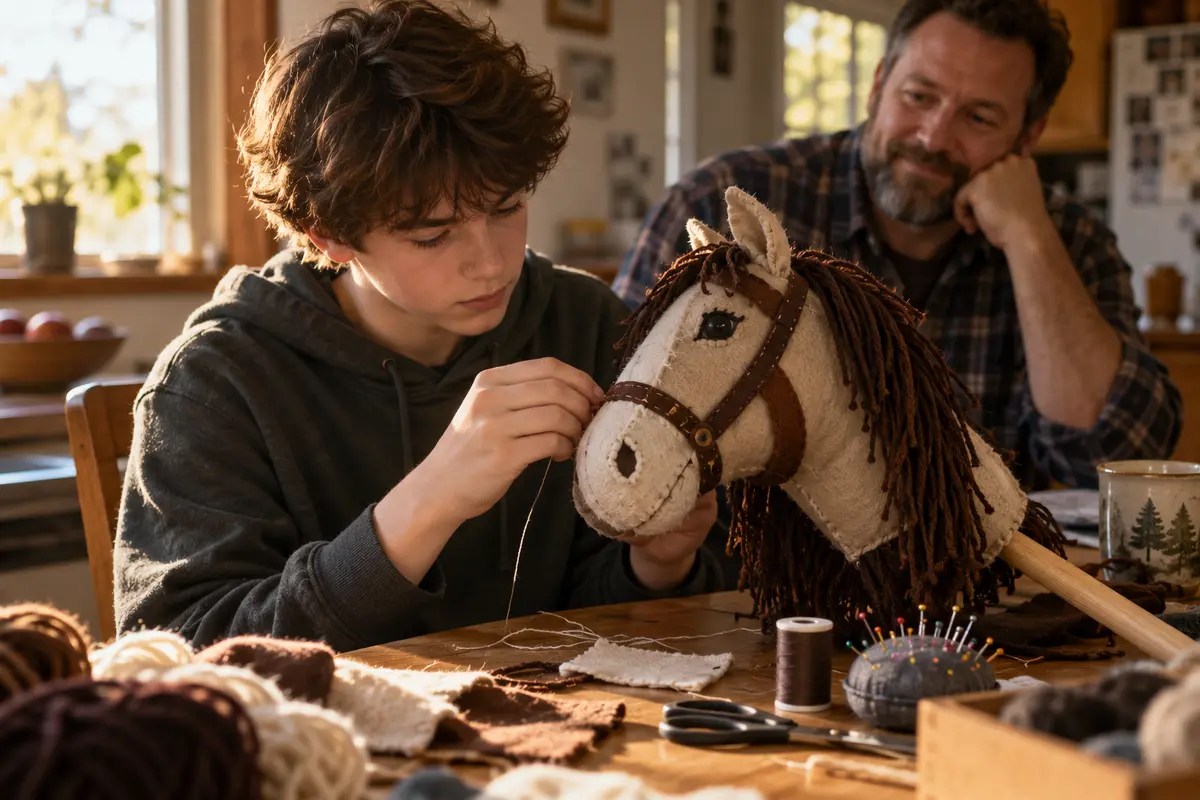
A young person carefully stitches a handmade hobby horse at a kitchen table while a parent watches nearby.

Adults are good at respecting a child’s interest after it becomes useful.

If it earns a scholarship, we call it dedication. If it makes money, we call it talent. If it fits neatly on a résumé, we call it well-rounded. But before any of that—especially when the interest looks odd—we often ask joy to explain itself.

Where is this going?

Can you make a living doing that?

What will people think?

We ask childhood to produce a business plan.

Fatherhood has shown me how easily anxiety can dress itself up as wisdom. We know the world can be cruel, so we try to protect our children from being embarrassed. Sometimes, though, our version of protection is to teach them embarrassment first. We offer the first small laugh. We suggest a more respectable interest. We make them feel foolish at home before somebody else can do it in public.

My children have brought me songs, drawings, games, sports, and ideas that did not arrive with a clear destination. Sometimes I understood the appeal immediately. Sometimes I had to resist grading the interest by whether I could picture it becoming a career.

That’s harder than it sounds.

We’ve been trained to look for proof. Yet some forms of intelligence announce themselves on report cards, while others appear when a child memorizes every detail of an imaginary world, edits the same song for the twentieth time, learns to stitch a bridle, or practices one jump until the body finally does what the mind can already see.

The child who seems ordinary inside an assigned format may come alive inside a chosen one.

That’s not a guarantee. It’s a clue.

Of course, honoring joy doesn’t mean funding every interest without limit or surrendering every boundary in the house. Parents still have to say no. Money is real. Time is real. Responsibilities are real. But there’s a difference between saying, “We cannot buy that,” and saying, “What you love is ridiculous.”

One sets a limit. The other turns a light down.
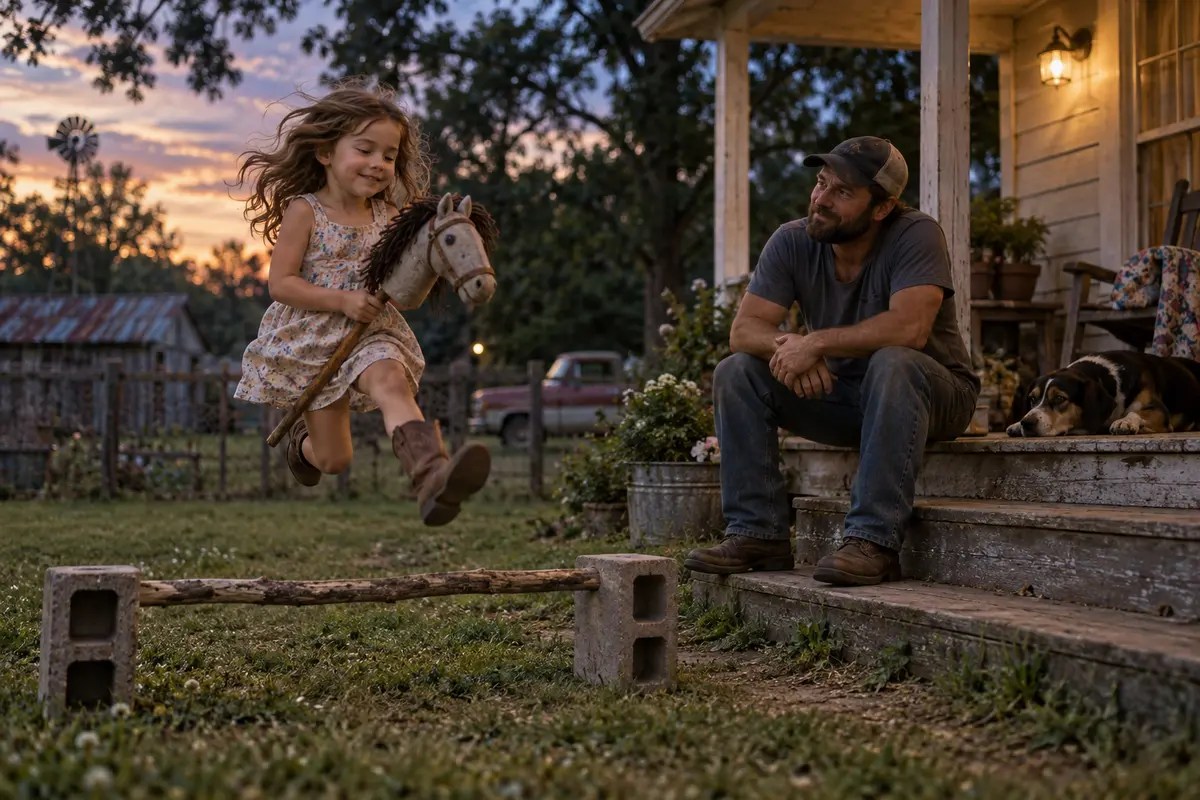
A father watches with quiet pride as his child practices a hobby-horse jump in a small-town Arkansas yard at dusk.

The interest may fade. Many do. The stick horse may end up in a closet beside some other season of childhood. That doesn’t make the joy wasted. A child may have learned to make something, practice something, risk being seen, and find a community. More importantly, the child might have learned whether the people at home made room for the parts of them the rest of the world hadn’t learned to value yet.

We don’t have to understand every enthusiasm our children bring us. We don’t have to pretend everything they make is excellent. Unconditional belonging is not the same as automatic approval.

But attention is not the same as approval either. Sometimes attention simply says: I see that this makes you more alive, and I will not make you ashamed of that.

A parent doesn’t have to understand the horse to recognize that the light in the child is real.

Sources: Morning Brew, “Youth Sports Brew” and Young Rider, “US Hobby Horse Championships Returns August 1, 2026 to Brighton, Michigan”.


Potential Has an Undefeated Record

There is a moment in writing when the work stops belonging only to you.

For a long time, the book was a collection of notes, half-finished ideas and sentences scattered across more files than any responsible adult should create. It was mine in the safest possible way. I could work on it when inspiration showed up, ignore it when life got loud and still tell myself I was writing a book.

Then I finished it.

That should have felt like relief. Instead, I stared at the file and realized finishing had created an entirely new problem.

Somebody else could read it now.

As long as the book remained unfinished, it could still be great. Not actually great, of course. Theoretical greatness is much easier. In my head, every unfinished chapter contained exactly the right words. Every joke landed. Every emotional moment struck the perfect balance between honest and self-indulgent. The imaginary reader closed the imaginary book and stared thoughtfully into the imaginary distance.

Reality is less cooperative.

A real reader can become bored. A real paragraph can fall flat. A real book can receive a very real shrug.

Potential has an undefeated record because potential never has to play the game.

The job you never apply for never rejects you. The person you never ask never says no. The business you never start never fails. The difficult conversation you never have never goes badly. The shot you never take cannot miss.

Of course, it cannot go in either.

That is the bargain we make when we protect our potential. We avoid one outcome by eliminating both.

I have always believed I was capable of more than my circumstances showed. That belief has helped me survive difficult seasons. It has also occasionally become a hiding place.

If the better career, finished book or improved version of myself remained somewhere in the future, I could keep believing it would be exceptional. Reality had not measured it yet. I was not failing. I was simply waiting for the right time, the right opportunity, the right energy or the right alignment of the planets.

Fear owns a surprising number of respectable outfits. Sometimes it dresses like preparation. Sometimes it calls itself patience. Sometimes it brings a legal pad, asks seventeen responsible questions and convinces us that one more round of thinking is the same thing as progress.

Preparation matters. Timing matters. Some decisions deserve patience.

But eventually we have to ask whether we are preparing to act or preparing an explanation for why we never did.

When I sent the manuscript to its first readers, I felt exposed in a way that surprised me. These were not strangers on the internet. They were people whose opinions mattered. They would see the seams. They would know where I had reached for something and missed it.

They might also find something useful.

That possibility only became available when I stopped protecting the other one.

The book is called A Nobody’s Guide to Self-Help. The title is partly a joke and partly a confession. I am not offering the wisdom of a man who conquered the world. I am offering a few landmarks from a man who has walked into enough holes to recognize some of them in the dark.

Writing it taught me something I probably should have learned sooner: evidence is less flattering than potential, but it is far more useful.

Evidence can be improved.

You can revise a bad paragraph. Learn from the interview you did not ace. Adjust the business after the first month. Recover from an awkward conversation. Practice the shot you missed.

Potential cannot be improved because it refuses to become anything.

So this is not a motivational demand to quit your job by lunch, empty your savings into a dream or confess your love to somebody who has made it very clear they would prefer you remain several counties away.

It is a smaller challenge.

Identify one thing you have kept safely theoretical. Then find the smallest honest action that would allow reality to touch it.

Send the email.

Submit the application.

Share the draft.

Ask the question.

Take the shot.

You may miss. I may too.

But undefeated is not the same thing as accomplished.

What part of your potential are you protecting from the possibility of becoming evidence?